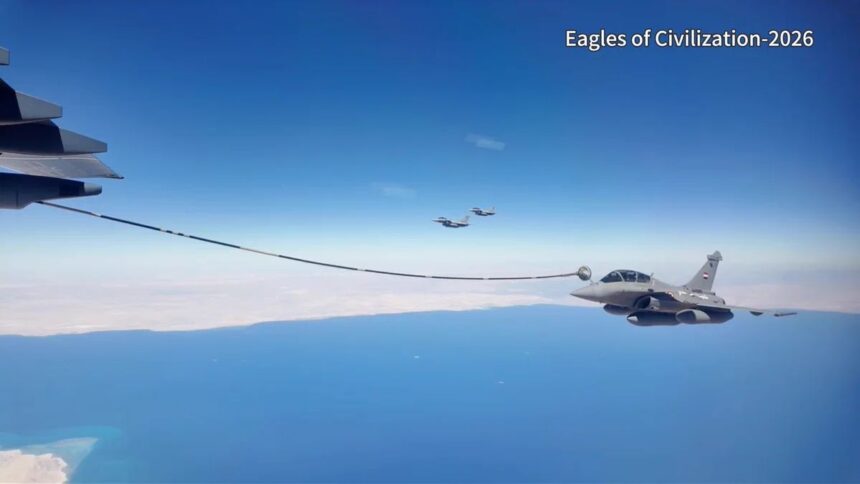
China and Egypt concluded their second consecutive year of advanced joint air combat exercises this week, dubbed Eagles of Civilization 2026. A new report from the Africa Center for Strategic Studies, a Washington-based research institution affiliated with the US Department of Defense, says the drill marks a turning point in Beijing’s military ambitions across Africa and the wider Middle East.
A Bigger, More Advanced Drill Than Before
The exercise saw China deploy six Shenyang J-16 fighter jets, aerial refueling tankers, strategic transport aircraft, an airborne early warning plane, and helicopters to Egypt, flying an integrated combat package more than 6,000 kilometers across two continents in roughly nine hours, according to the Africa Center report, authored by researcher Paul Nantulya.
Egyptian pilots flew French-made Rafale fighters against the Chinese J-16s, marking the first time China’s J-16 has faced off against an advanced Western jet outside Asia. Chinese President Xi Jinping traveled to Egypt during the exercise, an unusual move that analysts say signals how important Beijing considers the relationship.
Part of a Broader Pattern
China has conducted 24 military exercises in Africa since 2000, with the pace and sophistication accelerating sharply since 2018. Recent drills include naval exercises with Russia, South Africa, and Iran, along with a large scale land and sea exercise with Tanzania and Mozambique in 2024 that involved more than 2,000 troops, the report says.
Analysts quoted in the report say the exercises are increasingly designed to build China’s own long range warfighting capabilities rather than to train African militaries, and that African governments have limited ability to shape how the drills are run.
What It Means for Israel
Egypt has maintained a peace treaty with Israel since the 1979 Camp David Accords, and the two countries currently coordinate closely on issues including the flow of aid into Gaza and mediation between Israel and Hamas. A deeper Chinese military relationship with Cairo does not threaten that peace treaty directly, but it does add a new variable to a security relationship Israel has depended on for decades.
Israeli officials have generally been less vocal than Washington about China’s growing footprint in Egypt, though Israel shares the broader Western concern that expanded Chinese military access in the Eastern Mediterranean and Red Sea region could complicate the security environment along its borders and shipping routes. The Suez Canal and the Red Sea corridor are critical to Israeli trade, and any shift in which outside powers have influence over that waterway carries strategic weight in Jerusalem, even if Cairo insists it is simply diversifying its partnerships rather than choosing sides.
What It Means for the United States
Egypt remains one of the largest recipients of US military aid in the world, receiving roughly 1.3 billion dollars annually since 1979, and it co-hosts Bright Star, one of the US military’s largest and longest running multinational exercises in the region, alongside Central Command. That relationship gives Washington deep, decades old ties that China cannot easily replicate.
Still, a recent analysis published by US Central Command’s own media outlet, CENTCOM Citadel, acknowledged that China’s expanding presence within CENTCOM’s area of responsibility is a deliberate and sustained effort, even while arguing that Washington’s broader network of partnerships remains difficult for Beijing to match. The concern for US officials is less about Egypt abandoning its relationship with Washington and more about a gradual normalization of Chinese military access, weapons sales, and training across a region the US has treated as its own sphere of influence for decades.
China has already used its Africa exercises for defense marketing, showcasing its J-10 fighter jets to African buyers, with Algeria reportedly preparing to receive Chinese J-10Cs, and several other African nations already flying Chinese built jets. For Washington, each new Chinese arms sale or basing arrangement on the continent chips away at a security architecture built up over generations.
Egypt’s Balancing Act
Egyptian officials describe their approach as diversification rather than realignment. Cairo based analyst General Samir Farag has said Egypt maintains a mixed portfolio of partnerships, noting that Egypt still operates more than 200 US made F-16 fighters alongside its smaller fleet of French Rafales and continues to co-host Bright Star with the United States.
Whether that balancing act holds over the long term, or whether deeper Chinese military ties gradually pull Egypt toward Beijing’s orbit, is likely to remain a central question for policymakers in Washington and Jerusalem as China’s presence across Africa continues to expand.