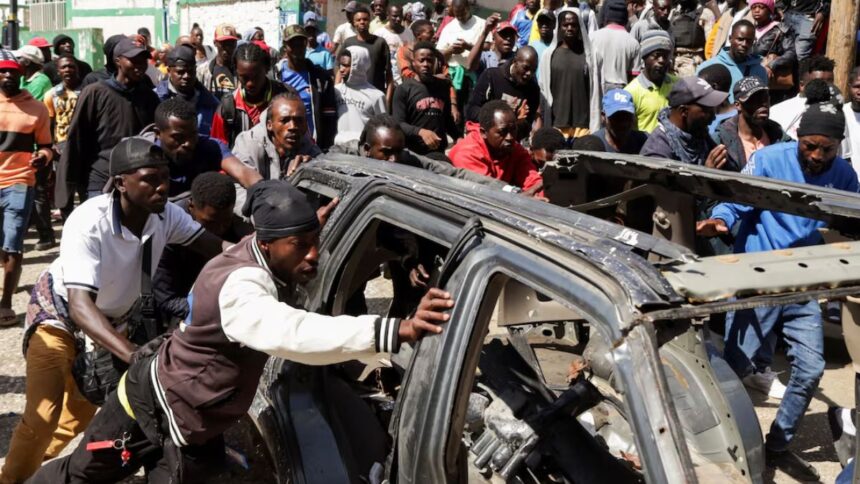
At least 47 people were killed and more than 50 others kidnapped when armed gangs attacked Kenscoff, a hillside community near Haiti’s capital, in what the United Nations described as one of the largest mass kidnappings the country has seen in recent years.
What Happened
The attack struck Kenscoff, a community in the hills overlooking routes into Port-au-Prince, on the evening of August 23. The UN said 22 additional people were injured in the raid. UN Secretary-General Antonio Guterres condemned the assault, saying it underscored what he called the alarming security situation in Haiti driven by armed gangs.
In a video posted to social media, a gang member identifying himself as Izo 2, a reference to gang leader Johnson Andre, threatened Haitian National Police director Vladimir Paraison directly. “Paraison, if any of our soldiers are hurt, I will kill all of them,” he said, referring to the hostages.
A Community That Had Seen Repeated Attacks
Kenscoff has been targeted by armed gangs roughly a dozen times since last year, forcing thousands of residents to flee their homes, according to Al Jazeera. Security operations between January and August had reduced violence in the area by 66 percent prior to Sunday’s attack, according to figures cited by the UN, a gain that Romain Le Cour, head of the Haiti Observatory at the Global Initiative Against Transnational Organized Crime, said made the assault a major test for the government, police and international mission alike.
Haiti’s National Police said director Paraison has ordered an investigation into whether police failures, including possible complicity or negligence, contributed to the scale of the attack. Some survivors have accused authorities of failing to provide adequate protection beforehand, an accusation the police have rejected.
Government Response
Haiti’s prime minister’s office said in a statement that “Kenscoff will not be abandoned” and pledged that “the government’s authority will be restored, without weakness and without delay.” Armed groups are estimated to control roughly 70 percent of Port-au-Prince and parts of Haiti’s central region, according to UN figures.
Why It Matters
The attack comes as Haiti prepares for what would be its first general election in more than a decade, planned for December, and raises fresh doubts about whether security gains claimed by the government and international forces can hold in communities beyond the capital’s core. Analysts have described the gang’s threat to kill hostages if security forces intervene as a deliberate trap, one that leaves authorities facing criticism whether they act or hold back.