Iran-backed Houthi forces seized the Red Sea port city of Mocha on Thursday, expanding their control over Yemen’s coastline and moving closer to dominating the Bab el-Mandeb Strait, one of the world’s most important shipping chokepoints.
Government troops withdrew from the city as Houthi fighters advanced, according to Al Jazeera. Tariq Saleh, deputy head of Yemen’s Presidential Leadership Council, described the pullback as a “tactical withdrawal” meant to let forces regroup rather than a collapse.
Rashad al-Alimi, the council’s head, said the fall of Mocha was “not a purely Yemeni affair” but a regional and international matter that demanded a wider response. Foreign Minister Afrah al-Zouba sent a message to the United Nations Security Council asking for firm international action.
Rajeh Badi, Yemen’s ambassador to Qatar, went further, accusing Tehran directly of “reigniting the war” by backing the advance. Houthi spokesman Mohammed Abdul Salam rejected that framing, saying the operation was about asserting sovereignty and insisting that “navigation and international trade in the Red Sea remain safe.”
Defense analysts were less reassured. Wolfgang Pusztai called the loss of Mocha “a very significant blow against the government,” while Saudi foreign policy analyst Abdulaziz Alghashian described the Houthi advance as “concerning,” attributing much of its success to disarray among anti-Houthi forces on the ground.
Saudi Arabia responded with roughly 40 additional airstrikes on Houthi positions across several governorates on Thursday, and government commanders have pledged to prevent further advances as Houthi units push south toward Dhubab.
Why the strait matters
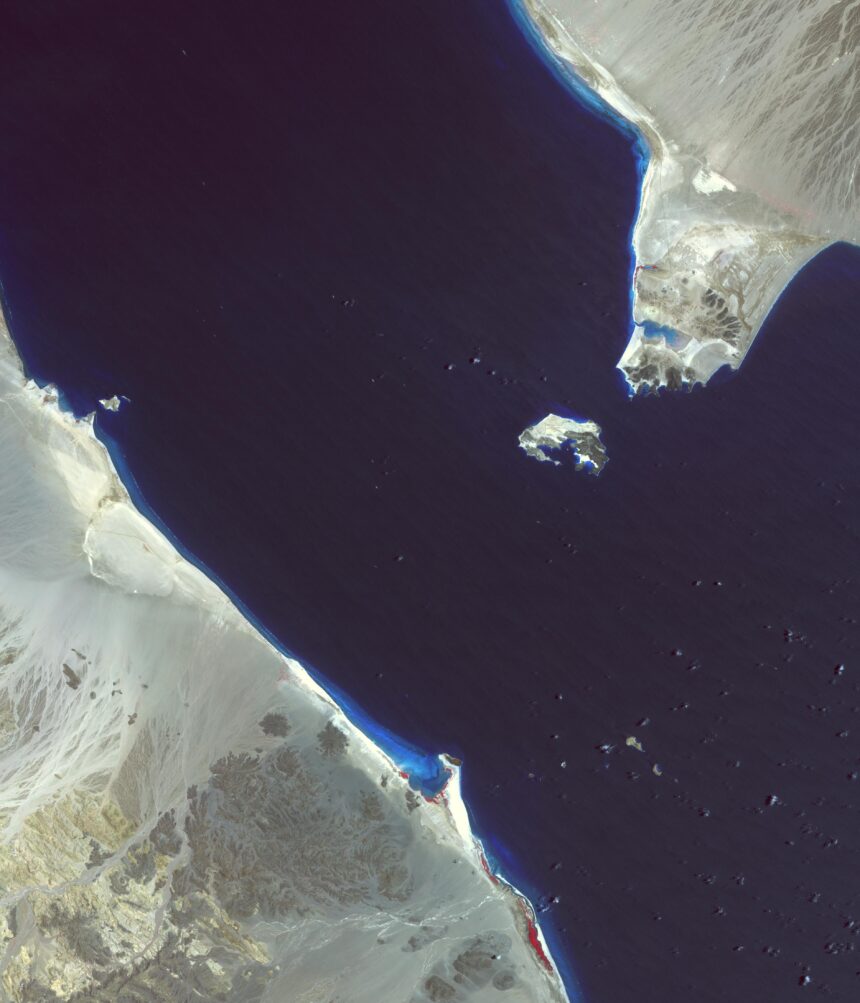
Bab el-Mandeb, together with the Strait of Hormuz, handles about a quarter of the world’s daily petroleum and crude shipments and close to a third of global maritime trade, linking Asia to Europe through the Red Sea and the Suez Canal.
A Yemeni military spokesman warned that by pressing toward Mocha and its port, the Houthis are trying to establish a permanent presence on the strait and “transform the area into a situation resembling that of the Strait of Hormuz,” where Iran has long used its geography as leverage.
The group is also reported to be eyeing Zuqar Island, already captured after rocket attacks and a ground assault, along with Perim Island, as it works toward effective control of the narrow waterway. Some reports suggest the Houthis are consulting with Tehran on imposing “safe passage tolls” on ships transiting the strait, echoing Iran’s posture at Hormuz.
The uncertainty has already fed into markets. Oil prices crossed $100 a barrel on Thursday for the first time in months, a jump traders linked directly to the fighting and to earlier Houthi strikes on tankers and oil infrastructure in the region.
The battle for Mocha is the latest turn in a war that has run, in various phases, since 2015, when a Saudi-led coalition intervened after the Houthis overran the capital, Sanaa, and forced Yemen’s internationally recognized government into exile. Repeated ceasefires and UN-mediated talks have failed to produce a lasting settlement, and control of the Red Sea coast has shifted back and forth between the two sides for years.
Pakistan’s stake in the fight
The escalation carries a direct Pakistani angle. Islamabad has urged Iran to restrain the Houthis, and officials have pointed to the newly signed Mecca Defence Pact with Saudi Arabia and Turkiye as a mechanism that could be activated if the fighting spills across the Saudi border.
Defence Minister Khawaja Asif said plainly that “if there is unprovoked aggression, or a spillover of whatever is happening in Yemen into Saudi Arabia, definitely the Mecca agreement will become operational,” according to Al Jazeera.
The pact, signed last month, binds Pakistan, Saudi Arabia and Turkiye to a NATO-style arrangement under which an attack on one is treated as an attack on all three, though how it would be implemented in practice remains untested. Together the three countries field roughly 1.4 million active troops, about 3,400 military aircraft, 6,000 tanks and more than 340 naval assets, giving the pact considerable weight on paper.
For Pakistan, the stakes go beyond treaty obligations. A sustained rise in oil prices driven by Red Sea instability would add pressure to an import bill that already strains the country’s foreign exchange reserves, and any escalation drawing in Saudi Arabia could test Islamabad’s newly formalized defense commitments for the first time.
Saudi Arabia has already been targeted directly. Houthi missile attacks on the kingdom’s south wounded at least 73 people earlier this week, according to reporting cited by Pakistani officials when they reaffirmed the pact’s relevance. That strike is widely seen as the immediate trigger for Islamabad’s public statements this week.
For now, Pakistan has stopped short of any statement on Iran’s specific role in directing or arming the Houthis, focusing instead on its defense obligations to Saudi Arabia. But with oil prices climbing and a key global shipping route increasingly contested, the fighting around Mocha is being watched in Islamabad as closely as it is in Riyadh and Tehran.