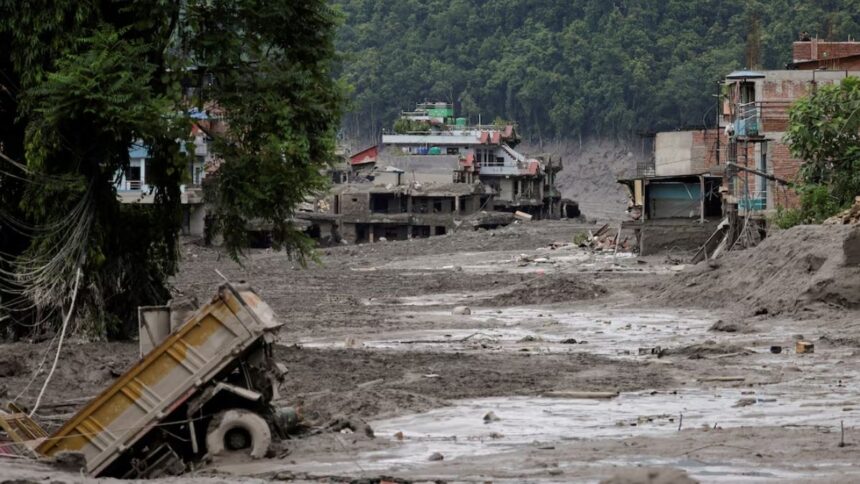
The death toll from the Nepal-Tibet flash flood has surged past 469, with nearly 1,000 people still missing, as authorities on both sides of the border warn that an unstable new barrier lake threatens further catastrophic flooding in the disaster zone.
A Toll That Keeps Climbing
Nepal’s prime minister’s office said Friday that 469 people had been confirmed killed, with 977 still missing, up sharply from the initial estimate of 95 deaths reported in the hours after Wednesday’s disaster. Nepal Police said 186 of the recovered bodies were found in Chitwan district, dozens of miles downstream from the hardest-hit areas near the border. Authorities say 644 of the missing are foreign nationals, with the US State Department confirming 90 Americans remain unaccounted for, though it said it was not aware of any confirmed US deaths.
In Tibet, Chinese authorities raised their death toll from three to five, with 558 people, including 260 foreign nationals, still listed as missing following a mudslide that struck a land crossing in Gyirong county. It remains unclear whether the Nepali and Chinese casualty counts overlap for people who crossed the border. Nepal has deployed roughly 8,380 police personnel and 30,000 security personnel to search remote valleys, and says about 1,545 people have been rescued so far.
A New Threat: An Unstable Barrier Lake
Rescue efforts in both countries were temporarily halted after officials identified a newly formed barrier lake straddling the Nepal-China border, created when the initial flood and landslide debris dammed a river. Chinese authorities said the lake held roughly two million cubic metres of water and was expected to receive another three million cubic metres over the following three days, raising fears it could burst and unleash a second wave of flooding downstream.
Bishal Nath Upreti, president of the Nepal Centre for Disaster Management, described the situation for those still stranded in the disaster zone as “extremely difficult,” noting there are no roads to reach some affected communities. Rescue and military teams attempting to reach the Gyirong border crossing, where buildings lie buried under mud up to one and a half metres deep, have been ordered to pause work over fears of further mudslides.
What Caused the Disaster
Chinese Foreign Ministry spokesperson Lin Jian said both Nepal and China have confirmed the flood was triggered by a high-altitude glacial collapse, which sent a surge of ice, water, rock and mud down river valleys in the northern Rasuwa district around 8:40am local time Wednesday. The flooding inundated communities along the Trishuli River, destroying bridges, roads and hydropower plants, with satellite images showing entire village footprints wiped clean in the hardest-hit areas.
International Response
US President Donald Trump said Washington was willing to send “any help” to Nepal following the disaster. The scale of destruction, combined with the ongoing threat from the barrier lake, has made this one of the deadliest natural disasters in Nepal’s recent history, with officials in both countries cautioning that the death toll is likely to rise further as search operations continue.
Why It Matters
With rescue operations paused in places due to the barrier lake threat and hundreds of foreign tourists still unaccounted for, officials face a race against time to reach stranded survivors before further flooding or worsening weather cuts off access altogether. The disaster has renewed scrutiny of glacial lake monitoring across the Himalayan region, where climate change has been linked to a rising frequency of such events.