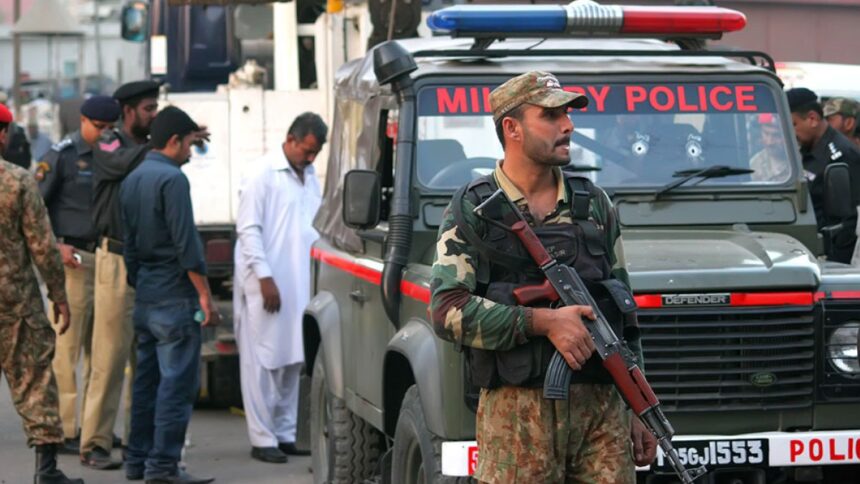
Pakistani security forces ended a 20-hour standoff with militants in Kohat, Khyber Pakhtunkhwa, on Saturday after a coordinated assault on a police compound left at least 23 people dead and more than 100 wounded, according to Dawn.
The attack began Friday during prayers, when a suicide bomber rammed an explosives-laden vehicle into a mosque inside the city’s old Police Lines complex. Gunmen then stormed the facility, which houses the Special Branch intelligence office, the Counter Terrorism Department, and residences of counterterrorism officers.
Security forces spent the following night clearing the compound room by room before declaring the operation over on Saturday morning.
Casualties and clearance operation
Of the 23 confirmed dead, 17 were police personnel and six were civilians, Dawn reported, citing local officials. Among those killed were SP Traffic Akbar Shinwari and Dr. Israel Orakzai, head of the pediatric department at Kohat’s District Headquarters Hospital.
More than 100 people were wounded. Seven of the most seriously injured were referred to hospitals in Peshawar for specialized care, while over 60 Rescue 1122 personnel and two dozen vehicles were deployed across the district to handle the response.
Police said eight attackers were killed during the overnight clearance, though Interior Minister Mohsin Naqvi put the figure at seven, not counting the bombers. A Counter Terrorism Department statement said an additional inspector general sustained a hand injury in a grenade blast but returned to the frontline.
Khyber Pakhtunkhwa Inspector General Zulfiqar Hameed said police, CTD personnel, and security forces “fought valiantly,” calling the officers involved “the pride” of the force. Naqvi said the officers who died “set the highest example of duty by sacrificing their lives.”
President Asif Ali Zardari and Prime Minister Shehbaz Sharif each issued separate statements condemning the assault.
Who is responsible
No group had claimed the attack as of Saturday, though a faction calling itself the Hafiz Gul Bahadur-led Ittehadul Mujahideen said it carried out the assault, according to Dawn’s reporting. Pakistani officials have also pointed to the Tehreek-i-Taliban Pakistan, which the government refers to in official statements as “Fitna al-Khawarij,” a label meant to strip the group of religious legitimacy.
Pakistan’s Ministry of Information described the attackers as “the vilest of Khawarij with roots in Afghanistan” and said terrorism “has no religion and no justification.” The ministry added that Pakistan has “both the will and the capability to eliminate terrorist threats wherever they are.”
Islamabad has repeatedly accused Afghanistan’s Taliban government of sheltering TTP commanders and allowing cross-border attacks to be planned from Afghan soil, an allegation Kabul denies. Wire Examiner reported earlier this month that talks between the two governments on the issue had stalled over Islamabad’s demand for concrete action against militant sanctuaries.
The Hafiz Gul Bahadur network has operated for years out of North Waziristan, along the same Afghan border belt as Kohat, and has previously targeted military and police convoys rather than claiming large mass-casualty bombings. If the group’s claim of responsibility for Friday’s attack is confirmed, it would mark a significant escalation in both the scale and the target selection of its operations.
A pattern of attacks in the northwest
The Kohat assault is the latest in a string of attacks and counter-militancy operations across Khyber Pakhtunkhwa and neighboring Balochistan this year. Pakistani security forces reported killing 11 militants in operations across the two provinces in late August, and 49 more earlier that month, according to Wire Examiner’s coverage at the time.
The scale of the Kohat attack recalls the 2023 bombing of a mosque inside a Peshawar police compound, which killed more than 100 people, most of them officers, in one of the deadliest assaults on Pakistani security forces in years. Friday’s attack, targeting personnel at prayer inside a secured facility, follows a similar method: strike where officers are gathered and least able to respond quickly.
Why it matters
The attack underscores how exposed even hardened security installations remain to coordinated militant assaults, despite months of stepped-up operations against TTP-linked networks in the northwest. Kohat sits along a corridor that security analysts have long flagged as vulnerable to fighters moving across the Afghan border.
It also adds pressure on Islamabad’s diplomacy with Kabul at a delicate moment. Pakistan has been pushing the Afghan Taliban to act against groups it blames for a rising number of attacks, without success so far, and each new mass-casualty incident narrows the room for a negotiated de-escalation.
For families in Kohat, the toll is more immediate: officers who reported for duty and worshippers who gathered for Friday prayers are now among the dead, a reminder that the burden of Pakistan’s long-running counterinsurgency continues to fall heaviest on ordinary police and the communities where they serve.
The attack also lands as Pakistan’s civilian and military leadership continue to publicize successes against militant networks elsewhere in the country. Friday’s assault shows that despite recent large-scale operations in Balochistan and Khyber Pakhtunkhwa, attackers retain the ability to strike hardened targets in the province’s settled districts, not just its more remote tribal areas.
Rescue operations and hospital treatment for the wounded were continuing in Kohat and Peshawar as of Saturday, according to local officials.
Image: File photo of a Pakistani security forces vehicle. Credit: Voice of America (public domain), via Wikimedia Commons.