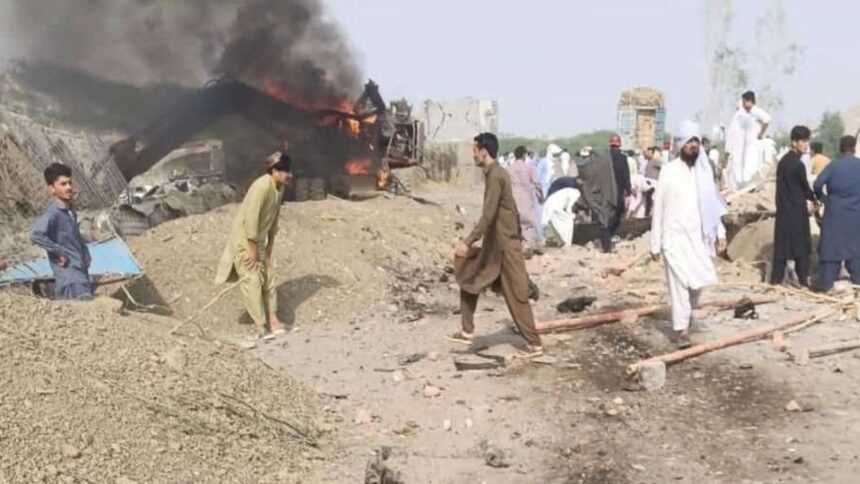
A suicide bombing tore through a police checkpost in Dera Ismail Khan on Friday, killing at least 11 people and wounding more than 30 others in one of the deadliest attacks to hit Khyber Pakhtunkhwa in recent weeks.
The attacker rammed an explosives laden tractor trolley into the Aman Mela checkpost in the Darazinda area, near Mughal Kot on the DI Khan-Quetta Road close to the Balochistan border, according to Dawn. The checkpost is jointly staffed by police and customs officials who monitor cross border smuggling along the route.
Local officials gave slightly different casualty breakdowns as the toll continued to be updated through the day. Geo News reported that six police personnel and two customs officials were among the 11 dead, along with two women and a two year old child, while more than 30 people were wounded, some critically. Dawn’s count put the toll at 12 killed and 35 injured, with police confirming that no security personnel were among that day’s fatalities, suggesting most of the dead were bystanders and traders passing through the checkpoint.
Rescuers targeted in follow up attack
The violence did not end with the initial blast. Rescue workers responding to the scene came under gunfire, and two ambulance staff, identified as Sharifullah and Imtiaz, were killed while a third, Anees, was wounded, Dawn reported. Attacks on medical responders during active incidents have become a recurring and troubling feature of militant operations in the province.
District Police Officer Ziauddin Ahmed confirmed the blast was a suicide attack. State broadcaster Radio Pakistan attributed responsibility to what it called “Fitna al Khawarij,” the government’s preferred label for the banned Tehreek-i-Taliban Pakistan. No group had formally claimed the attack at the time of writing.
Pakistan’s interior minister condemned the bombing as a “cowardly act” and said Khyber Pakhtunkhwa remains on the front line of the country’s fight against militancy.
Part of a wider surge in violence
Friday’s bombing adds to what has been a sharply escalating pattern of attacks across Khyber Pakhtunkhwa this year. Just over a week earlier, on September 18, a bombing at the Kohat police lines killed 23 people and injured roughly 100 more. Security analysts cited by local media noted that recorded attacks in the province rose by around 50 percent in August compared with July, from 36 to 54 incidents.
Analysts in Pakistani media have also pointed to a growing overlap between militant networks and cross border smuggling rings along the Balochistan-KP frontier, arguing that checkpoints like Aman Mela are being targeted precisely because they interfere with both militant logistics and illicit trade.
The attack came the same day that separate reports emerged of 18 workers abducted in Duki, Balochistan, underscoring how instability along the KP-Balochistan corridor has intensified on multiple fronts simultaneously.
Why it matters
Dera Ismail Khan sits on a key route linking Khyber Pakhtunkhwa to Balochistan and has repeatedly been a flashpoint for militant violence, given its proximity to tribal districts with a long history of insurgent activity. The rising frequency of attacks this year, capped by two mass casualty bombings within eight days, will add pressure on Islamabad to reassess its security posture in the region ahead of what officials have described as an intensified counter militancy campaign.
For residents of the area, the attack is a stark reminder that even routine customs and anti-smuggling checkpoints, rather than military convoys or urban centers, have become frequent targets, raising fresh questions about how exposed civilian and law enforcement infrastructure remains along Pakistan’s western frontier.
Image credit: Khuram Shehzad / Pexels