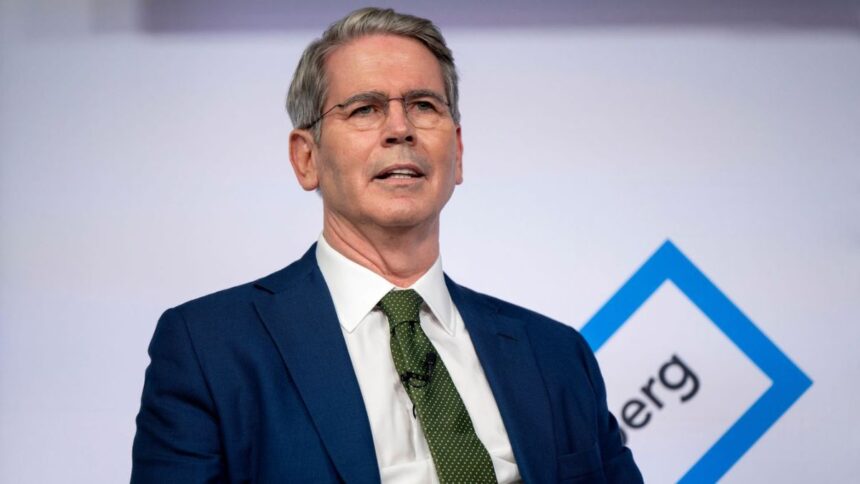
US Treasury Secretary Scott Bessent said Thursday that a new round of economic measures will ‘collapse’ the Iranian government, as Washington ramps up pressure on Tehran nearly six months into their war and pushes allies to join a coordinated campaign of economic isolation.
‘Toughest Sanctions in History’
Bessent told CNBC that the United States would combine its existing naval blockade on Iranian oil exports with what he called the toughest sanctions in the country’s history. “It is a one-two punch,” Bessent said. “We have the blockade, and we are going to have the toughest sanctions in history. It is going to work in Iran, and we are going to collapse this regime.” He said he would hold a news conference on Monday to detail the plan, and that Washington was telling allies they must choose a side.
The announcement followed a Wednesday night social media post from President Donald Trump, who said Iran had “failed to take” an opportunity to reach a deal and would face what he called economic warfare and isolation on an unprecedented scale. Trump also warned that any country whose financial institutions, businesses, airports or government entities provide a lifeline to Iran would itself face severe economic consequences.
Iran Pushes Back
Tehran has dismissed the threats. Iranian Foreign Minister Abbas Araghchi rejected the economic pressure, describing it as a policy that will only stir further instability rather than force concessions. Iran’s Foreign Ministry separately condemned what it called an “unlawful” escalation, warning that officials who order or carry out the new measures could face prosecution.
Iran’s Central Bank Governor, Abdolnaser Hemmati, has acknowledged that the country is not currently exporting oil and is facing foreign currency reserve shortages, rising youth unemployment and mounting reconstruction costs. Officials have said the domestic fuel supply situation has become a critical issue because of restricted access to foreign exchange and import logistics.
Allies Face a Choice
The United Arab Emirates has already announced it is severing trade and financial ties with Iran, a move that Washington has held up as a template for other governments in the region. Analysts note that a significant share of Iran’s remaining foreign exchange access runs through the UAE, meaning the move could compound the pressure on Tehran’s finances.
Bessent has not said whether the new measures will directly target China, one of Iran’s largest remaining oil buyers, a decision complicated by a planned state visit to Washington next month by Chinese President Xi Jinping. Some analysts tracking oil shipments estimate Iran may have enough crude already outside the blockade to sustain roughly four months of export revenue, after which income could fall toward zero if the squeeze holds.
Part of a Wider Standoff
The push for tighter sanctions comes as the US war with Iran remains in a diplomatic stalemate, with the Strait of Hormuz still a flashpoint and questions mounting over the toll the conflict has taken on the US military. Iran’s Islamic Revolutionary Guard Corps has separately warned it could deploy more “destructive” weapons should the conflict resume at scale.
Bessent’s planned Monday announcement is expected to lay out which sectors, banks and shipping networks will be targeted next, in what US officials are describing as a coordinated international effort rather than a unilateral American move.