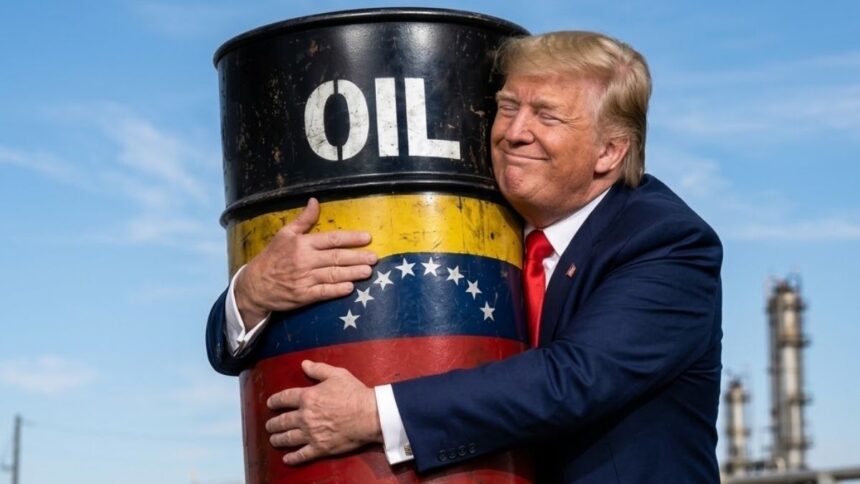
President Trump announced Friday that the United States has secured majority control of more than 65 billion barrels of Venezuelan oil reserves, calling it the biggest oil deal in world history.
“At my direction, Secretary of State Marco Rubio, and Secretary of War Pete Hegseth, working closely with Highly Respected Interim President of Venezuela, Delcy Rodriguez, and, through a partnership with private business, have secured majority U.S. control of more than 65 BILLION BARRELS of proven Oil Reserves in Venezuela, at no cost to the American Taxpayer,” Trump wrote on Truth Social.
How the Deal Is Structured
A US official told CBS News that interim Venezuelan President Delcy Rodriguez granted a private joint venture a 100-year concession to operate oil fields containing the 65 billion barrels. The joint venture combines the US government with an experienced private operator already active in Venezuela.
Under the arrangement, the US government will control 55 percent of the venture, split between direct equity and the ability to obtain oil from the fields at cost. Rodriguez’s government said separately that the deal covers 17 oil fields and could draw as much as $100 billion in investment into Venezuela’s petroleum sector.
A Massive but Underdeveloped Resource
Venezuela holds the largest proven oil reserves in the world, estimated at roughly 303 billion barrels, or about 17 percent of global supply. The 65 billion barrels covered by this agreement represents roughly 21 percent of that total.
Unlike many oil-producing regions where geologists still have to search for untapped deposits, Venezuela’s reserves are largely already mapped and known. But decades of underinvestment have left the country’s extraction infrastructure in poor condition, and it currently produces only about 1 percent of the world’s oil despite its enormous reserves.
The Context Behind the Timing
The deal follows a US military operation earlier this year that replaced Venezuela’s previous leadership, and comes as the Trump administration works to draw major oil companies back into the country. Independent firm Hunt Oil Company reportedly signed its own deal with state-run Petroleos de Venezuela earlier this month, though other companies have expressed caution given the industry’s troubled history in the country.
Trump is also facing mounting political pressure over gas prices, which have climbed as the six-month war between the US, Israel, and Iran continues to disrupt oil flows through the Strait of Hormuz. Average US gas prices stood at $4.09 a gallon on the day of the announcement, up from $3.21 at the same point a year earlier.
Not an Immediate Fix
Trump said the deal would substantially lower gas prices for Americans over the long term, but experts caution that any drop tied to the agreement will take time to materialize. Developing Venezuela’s aging oil infrastructure is expected to require years of work and billions of dollars in investment before the reserves can meaningfully add to global supply.
No text of the agreement has been publicly released, and key details, including how soon the fields could actually begin producing at scale and how the financing will work in practice, remain unclear.
Why It Matters
The agreement marks a significant shift in US energy policy toward Venezuela, a country Washington had spent years isolating through sanctions before this year’s change in leadership. Whether the deal delivers the scale of production Trump has promised will depend heavily on how quickly private investment and infrastructure repairs can catch up to the ambitions laid out in the announcement.