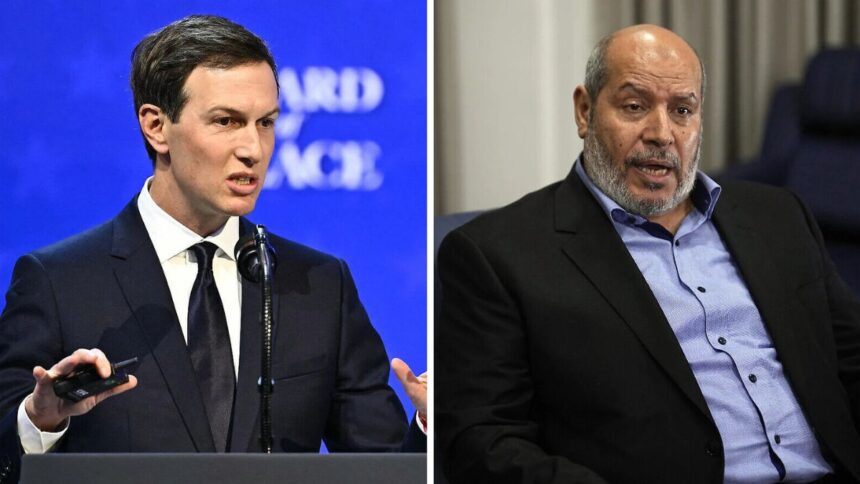
Jared Kushner, US President Donald Trump’s son-in-law and envoy, sat down with Hamas’s new leader in Egypt on Sunday, as Washington tries to salvage a Gaza peace plan that Israel has so far rejected, according to AFP.
The meeting took place in the Egyptian coastal city of El-Alamein and marked the first trip abroad by Hamas chief Khalil al-Hayya since he took over leadership of the group in July. Two weeks earlier, Hamas had endorsed the latest stage of Trump’s plan, agreeing to hand over weapons to a new governing committee. Some observers see that move as tactical, made with the expectation that Israel would refuse it anyway.
What Kushner Pressed For
During the talks, Kushner pushed for what one source described as “concrete, verifiable steps” toward disarmament, a central demand of Israeli Prime Minister Benjamin Netanyahu. He also relayed a message that Gaza “can never again be a source of terror for Israel.” Hamas, for its part, reaffirmed its commitment to the broader agreement, according to a second source with knowledge of the discussions.
A photo released by Egypt showed Kushner seated with other members of Trump’s so-called Board of Peace, including former British Prime Minister Tony Blair, alongside representatives from Qatar and Turkey, the two other key mediators in the process. Al-Hayya did not appear in the released image.
The direct engagement is notable given Washington’s long-standing policy of avoiding contact with Hamas, which the US designates a terrorist organization and holds responsible for the October 7, 2023 attack that triggered the Gaza war.
The Trump administration has grown increasingly willing to engage directly with the group as it works to end the conflict, building on the October ceasefire that secured the release of remaining Israeli hostages. Kushner was scheduled to meet Netanyahu on Monday, as the Israeli leader heads into a difficult re-election contest in October.
Muslim-Majority Nations Criticize Israel’s Rejection
Egypt, Qatar and Turkey were joined by Jordan, Saudi Arabia, the United Arab Emirates, Pakistan and Indonesia in a joint statement Sunday condemning Israel’s rejection of the plan. The eight nations said Israel “bears direct and full responsibility” for obstructing peace, and argued its refusal threatens to unravel the broader effort led by Trump.
Netanyahu’s Likud Party responded sharply, accusing Arab governments of trying to unseat the prime minister ahead of the election. The UAE’s involvement carries particular weight, since it normalized relations with Israel five years ago in a relationship Netanyahu has counted among his signature achievements.
Netanyahu has resisted the US plan even after receiving assurances from Nickolay Mladenov, the Board of Peace’s high representative for Gaza, that Israeli troops would not be required to withdraw from Gaza until Hamas completes disarmament. That marks a shift from the board’s earlier position, which had called for a phased Israeli withdrawal to run alongside Hamas’s disarmament process.
Violence Persists Despite the Ceasefire
The diplomatic push is unfolding against a backdrop of continued violence. Israel has resumed airstrikes in Gaza after a period of relative calm following the plan’s rollout, though the October ceasefire never fully stopped hostilities in the territory.
On Sunday, Israeli aircraft struck a house west of Nuseirat, injuring several people, according to Mahmoud Bassal, spokesman for Gaza’s Hamas-run civil defense agency. The Israeli military said the strike targeted an Islamic Jihad threat and that it took steps to limit civilian harm.
Separately, Israeli forces opened fire on tents sheltering displaced people west of Khan Yunis, injuring others, the civil defense agency said. The body of a child, identified as Suhail Shallouf, was recovered in the same area after he was killed by Israeli fire the day before.
Gaza’s Hamas-run health ministry, whose figures the United Nations considers reliable, says Israeli operations have killed at least 1,262 Palestinians since the ceasefire took effect on October 10. The Israeli military has reported five deaths among its own forces over the same period.