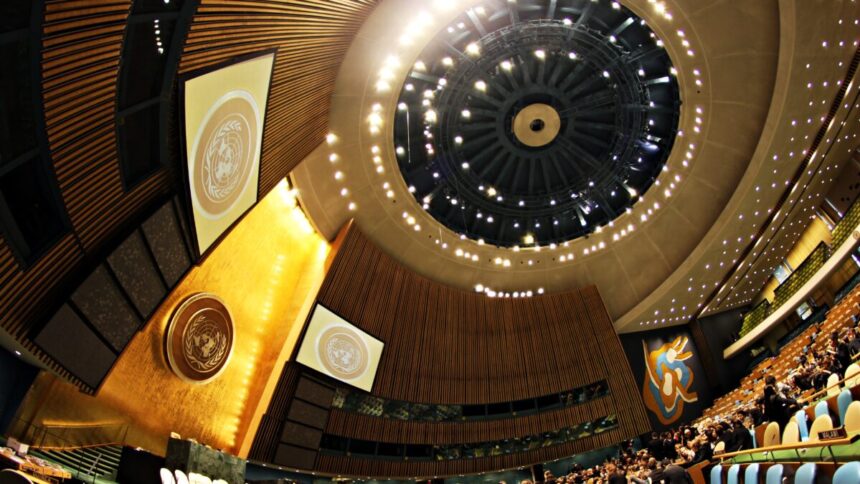
Israeli Prime Minister Benjamin Netanyahu addressed the 81st session of the United Nations General Assembly in New York on Thursday to a room that had largely emptied out before he said a word. Dozens of national delegations walked out as he approached the podium, leaving a hall that Israeli commentators described as strikingly bare for a head of government’s address.
Mass walkout as Netanyahu takes the podium
Seventy seven country delegations left the General Assembly chamber in the run-up to Netanyahu’s speech, according to Middle East Monitor, part of a wave of departures that has become a recurring feature of his UN appearances in recent years. Only a handful of delegations, including the United States, remained seated when he began.
Netanyahu opened with a jab at those who stayed to watch the exodus rather than leave immediately. “Before I begin, just a quick announcement: if there are any other moral cowards who haven’t yet left this hall, please do so now,” he said, according to the Tribune.
He went on to reject international criticism of Israel’s conduct in Gaza, telling delegates “Israel prevented genocide” and dismissing accusations of war crimes levelled by rights groups, UN officials and a growing number of member states over the past two years.
Ultimatum to Hamas over remaining hostages
Much of the speech focused on the 48 hostages Israel says remain in Gaza. Netanyahu addressed them directly, telling them Israel had not forgotten them, before turning to Hamas with a blunt warning that the group could either release the captives and surrender or be “hunted down,” Gulf News reported.
He said Israel “must finish the job” against Hamas and claimed Israeli forces had broadcast his remarks into Gaza itself, both through loudspeakers near the border and through hacked mobile phones, an assertion that could not be independently verified.
Netanyahu also used the platform to reject the wave of Palestinian statehood recognitions announced by Western and other governments this year, calling the move counterproductive to any eventual peace process rather than a step toward one.
Netanyahu-Mamdani feud spills onto the world stage
The Israeli leader carried a domestic American political dispute onto the UN floor. In a video released ahead of his speech, Netanyahu attacked New York City Mayor Zohran Mamdani directly, saying “shame on you, Mr. Mamdani” and accusing him of backing terrorism and inciting violence against Jewish people, NBC New York reported.
Mamdani, who has repeatedly called for Netanyahu’s arrest under the International Criminal Court warrant issued against him and has described him as a war criminal, hit back at a City Hall press event. He pointed to the killing of an 11 year old boy by Israeli forces days earlier in what had been designated a safe zone in Gaza, using the case to counter Netanyahu’s accusations rather than address them directly.
Protests outside, and a cautious note from Washington
Demonstrators gathered near the UN complex and around Times Square during the speech, calling for an end to the Gaza war, according to wire reports from the scene. The protests mirrored the walkout inside the chamber, reflecting how isolated Israel’s position has become at the annual gathering of world leaders even as its closest ally continues to back it diplomatically.
After the address, US President Donald Trump said he believed a Gaza ceasefire agreement was close, though he cautioned that earlier predictions of an imminent breakthrough had not panned out. Trump’s administration has spent much of the year pushing competing ceasefire frameworks, none of which has yet produced a lasting halt to the fighting.
Why this UNGA session looks different
Israeli leaders have faced walkouts at past General Assembly sessions, but the scale this year is notable. A year ago, dozens of delegations left during Netanyahu’s UNGA 80 address as well, but the exodus this time started before he even reached the podium rather than partway through his remarks.
The shift reflects two years of a war that has killed tens of thousands of Palestinians in Gaza, according to figures cited by UN agencies and health officials in the territory, alongside a steady stream of Western governments extending formal recognition to a Palestinian state over the past twelve months. Both trends have hardened positions on either side of the chamber well before speakers take the floor.
A familiar split in reaction
Coverage of the speech broke along predictable lines. Israeli outlet Channel 14 called the walkout “a spit in Israel’s face,” while Yedioth Ahronoth framed it as a dramatic act of protest. Haaretz was more critical of Netanyahu himself, describing the address as repetitive and arguing it was aimed more at his domestic right wing base and at Trump than at the assembly he was actually speaking to.
The scale of Thursday’s walkout underscores how UNGA’s annual leaders’ week has become as much a barometer of Israel’s diplomatic isolation as a forum for debate. With Gaza’s death toll still climbing and statehood recognitions piling up from capitals that once avoided the issue, this year’s session has offered little sign that the diplomatic gap between Israel and much of the world body is narrowing.