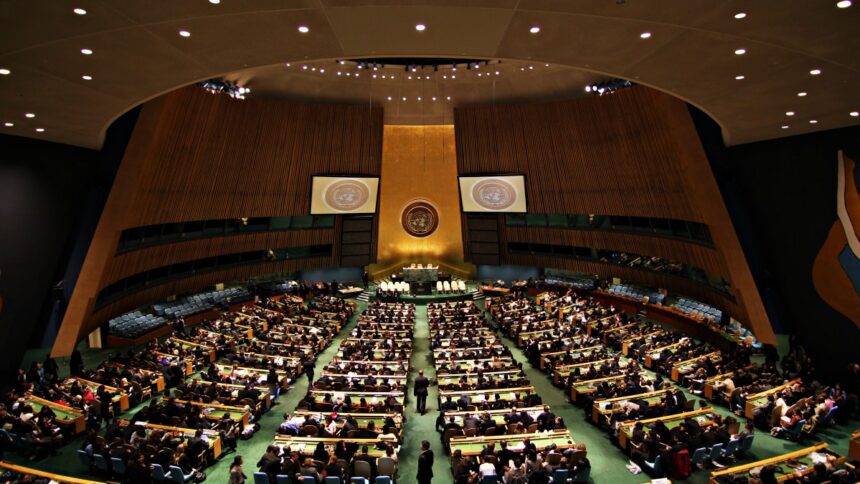
US Secretary of State Marco Rubio met Russian Foreign Minister Sergey Lavrov on the sidelines of the United Nations General Assembly’s 81st session in New York on September 23, according to Ukrainska Pravda. It was the fifth time the two officials have sat down together since 2025, following earlier meetings in Riyadh, Kuala Lumpur, New York and Manila.
The talks were held behind closed doors at UN headquarters. Journalists were permitted to film only the opening moments before being asked to leave the room, according to a report from Censor.net.
A packed Russian delegation
Lavrov did not arrive alone. His delegation for the meeting included Russia’s ambassador to the United States, Alexander Darchiev, the foreign ministry’s North Atlantic department director Alexander Gusarov, ministry spokeswoman Maria Zakharova, UN representative Vassily Nebenzia and foreign policy planning chief Alexei Drobinin.
Before the meeting, Lavrov said he expected to hear “Washington’s view of the situation in Ukraine” directly from Rubio.
Talks follow Trump-Zelenskyy meeting
The Rubio-Lavrov meeting came a day after Presidents Trump and Zelenskyy discussed ending the war “before winter” during their own meeting at the assembly, a timeline that has added urgency to this week’s diplomatic traffic in New York.
Russian state news agency TASS reported that Lavrov used the meeting to raise what he described as close coordination between “the Kiev regime and its European sponsors,” and that both sides discussed accusations of strikes on civilian areas and cross-border infrastructure. Moscow reiterated it remains committed to the goals of what it calls its “special military operation.”
Rubio, for his part, acknowledged that limited ceasefires on their own will not end the war. He pointed to a shared interest in arrangements covering grain and energy supplies as a possible starting point, while stressing that such steps alone would not resolve the broader conflict.
Bilateral relations also on the table
Beyond Ukraine, Lavrov pressed for a normalization of Moscow-Washington relations, including the return of Russian diplomatic property seized in the United States and the restoration of normal operating conditions for both countries’ missions. The two ministers also touched on the Middle East, the South Caucasus and Latin America, per TASS.
Why the venue matters
High-Level Week at the UN General Assembly has become one of the few predictable windows each year when senior Russian and American officials meet face to face, despite the broader freeze in relations since Russia’s full-scale invasion of Ukraine in 2022. The Rubio-Lavrov channel, now five meetings deep, functions as a parallel track alongside the more heavily publicized Trump-Zelenskyy and Trump-Putin exchanges, keeping a line of communication open even as fighting continues.
That contrast was on stark display this week. Even as diplomats spoke in New York, Russia and Ukraine continued trading drone and missile strikes on population centers and energy infrastructure, a reminder of how far the two sides remain from turning diplomatic contact into an actual ceasefire on the ground.
What comes next
No breakthrough was announced after the meeting, and neither side described the talks as producing a concrete agreement. The Kremlin has separately said it is “grateful” for a US invitation for President Putin to attend a G20 summit, a sign Washington and Moscow are keeping more than one diplomatic channel open at once.
The frequency of the Rubio-Lavrov contacts, combined with the Trump-Zelenskyy discussion of a winter deadline, suggests the Trump administration is betting on parallel tracks rather than a single point of leverage to bring the nearly four-year war to a close. Whether that approach yields results will likely become clearer once High-Level Week winds down and the diplomatic spotlight moves away from Turtle Bay.