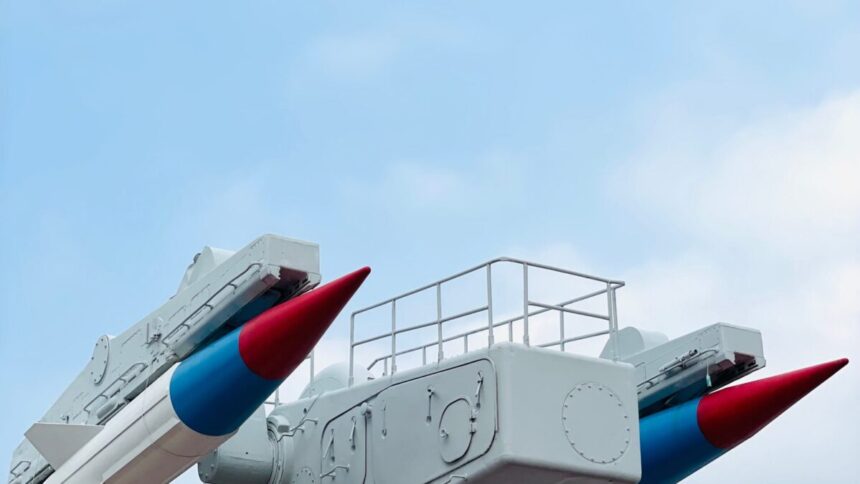
North Korea launched two suspected ballistic missiles toward the East Sea on Sunday, marking its 14th such test of 2026 and the latest in an accelerating pattern of weapons demonstrations from Pyongyang.
South Korea’s Joint Chiefs of Staff said the first missile was fired from the Wonsan area around 3 p.m. local time and flew roughly 450 kilometers, about 280 miles, before falling into the sea. A second projectile followed nearly three hours later and traveled more than 600 kilometers, according to military officials.
Japan’s Defense Ministry confirmed it detected a suspected North Korean missile but said it did not land in Japanese territorial waters. Neither government specified the exact missile type, though officials in Seoul described the weapons as short-range ballistic missiles.
South Korea’s National Security Office convened an emergency meeting with the Ministry of National Defense and the Joint Chiefs of Staff shortly after the launches. The presidential office urged Pyongyang to “immediately halt ballistic missile launches that are banned by U.N. Security Council resolutions,” calling the tests “a grave act.”
A record pace of testing
Sunday’s launches came just eight days after North Korea’s previous test on September 12, which followed the conclusion of Freedom Edge, a joint military exercise involving South Korea, the United States and Japan.
The frequency marks one of North Korea’s busiest testing years on record. Fourteen ballistic missile launches in under nine months outpaces the country’s average annual output through much of the past decade, underscoring how far Pyongyang’s weapons program has advanced despite years of international sanctions.
Kim Jong-un toured munitions plants from September 16 to 18, days before the latest launches. He told workers that North Korea’s artillery “must have the most concentrated, destructive, mass-scale and multidirectional strike power,” according to state media, and called for integrating artificial intelligence into the country’s weapons systems, a signal that Pyongyang is looking beyond conventional missile development toward more autonomous targeting and guidance technology.
Diplomacy stalls as drills shrink
The renewed testing comes even as President Trump has scaled back the scope of joint U.S.-South Korean military exercises, a move some analysts had hoped might create room for renewed dialogue with Pyongyang.
Kim Yo Jong, the North Korean leader’s influential sister, dismissed that gesture. She said scaled-down drills would not change what she called their “provocative, aggressive nature,” signaling Pyongyang has no immediate interest in returning to talks.
The stakes reach beyond the Korean peninsula. North Korea’s expanding missile arsenal, built almost entirely outside the global Nuclear Non-Proliferation Treaty framework, is regularly cited in debates over uneven enforcement of nonproliferation rules, a grievance Pakistani diplomats have raised at the United Nations when arguing that some nuclear and missile programs draw far heavier scrutiny than others. Pyongyang’s continued testing, largely unconstrained by sanctions that have been in place for years, is often pointed to as evidence that the current nonproliferation regime struggles to enforce compliance once a state has crossed the nuclear threshold.
For now, South Korea, the United States and Japan say they are maintaining trilateral surveillance and intelligence-sharing arrangements in response to the launches. Seoul’s military said it had increased monitoring along the east coast and was coordinating closely with Washington and Tokyo, though neither Seoul nor Tokyo signaled any change in its broader approach toward Pyongyang after Sunday’s tests.
That leaves the Korean peninsula in a familiar holding pattern of periodic missile launches, brief bursts of diplomatic condemnation and no clear path back to talks that have been stalled for years.