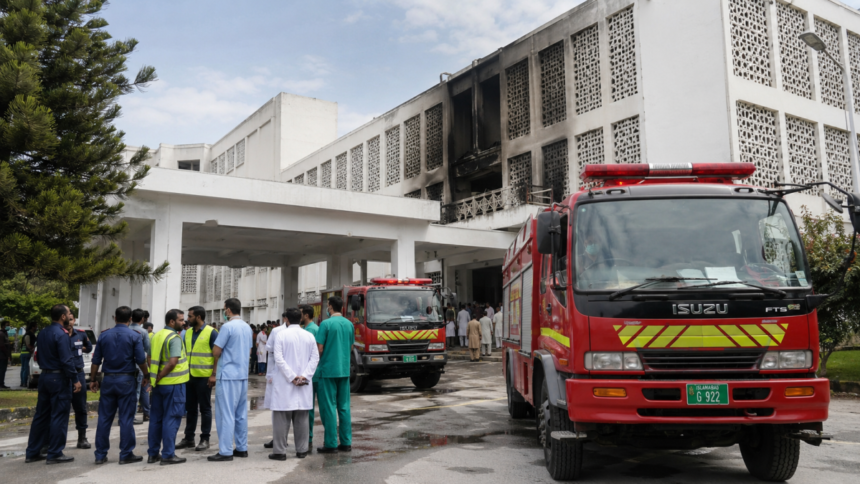
The deadly nursery fire at Islamabad’s PIMS hospital has exposed serious fire-safety gaps at major government-run hospitals in Karachi, with an Express Tribune investigation finding broken extinguishers, missing fire alarms and no emergency exits at two of the city’s largest public facilities.
The findings add to mounting pressure on provincial governments across Pakistan to urgently review hospital safety standards following the August 26 tragedy, in which 14 newborns died after a fire broke out in the neonatal intensive care unit at Islamabad’s Pakistan Institute of Medical Sciences.
Abbasi Shaheed Hospital’s Gaps
According to the Express Tribune report, Abbasi Shaheed Hospital, which is run by the Karachi Metropolitan Corporation, has only 13 fire extinguishers to cover its entire facility. Sources told the newspaper the hospital has never conducted a fire drill, and its staff has received no formal fire-safety training.
The hospital also reportedly lacks a fire alarm system and any dedicated emergency exit, leaving patients and staff dependent on ordinary staircases in the event of a blaze. The facility handles a significant patient load despite these gaps, with its emergency department receiving between 500 and 600 patients daily and more than 1,000 additional visitors passing through its outpatient department each day.
JPMC Faces Similar Questions
Jinnah Postgraduate Medical Centre, one of Pakistan’s largest public hospitals with more than 2,200 inpatient beds, handles over 2,000 emergency patients and more than 10,000 outpatient visitors daily. Despite that scale, questions remain over the adequacy of its own fire-safety arrangements.
Hospital officials maintained to the Express Tribune that firefighting equipment, trained personnel and emergency exits are available on site. However, the same report found that several of the hospital’s fire extinguishers were reportedly non-functional, and that JPMC similarly lacks a fire alarm system. Officials said the hospital instead relies on the Karachi Metropolitan Corporation Fire Brigade and Rescue 1122 in the event of a major blaze, underscoring a dependence on external emergency services rather than in-house fire suppression capability.
A Pattern Seen Elsewhere
The gaps identified in Karachi echo findings from the PIMS inquiry itself. A witness at the Islamabad hospital told Reuters the building housing the neonatal ward “had no fire security, no proper exits,” and a mother who lost her infant said the door to the intensive care unit had been locked at the time of the fire, according to AFP.
An initial government inquiry into the PIMS fire, submitted to Prime Minister Shehbaz Sharif days after the tragedy, similarly identified serious shortcomings in the hospital’s treatment and safety facilities and recommended disciplinary action against staff who were absent when the fire broke out.
A Wave of Reviews Ordered
The deaths have prompted federal and provincial authorities to order broader reviews of fire-safety measures and firefighting equipment across Pakistan’s public hospitals. In Punjab, the government has instructed the Health Department to immediately review fire-safety systems and emergency-response facilities at hospitals across the province.
UNICEF said it was “deeply saddened” by the deaths and called for an urgent review and strengthening of fire prevention and safety standards across health facilities nationwide. Sharif dismissed Health Secretary Aslam Ghauri, the Health Ministry’s highest-ranking civil servant, in the aftermath of the fire.
Why It Matters
Fires in large buildings remain frequent in Pakistan, often linked to poor safety laws, outdated electrical systems and lax enforcement of existing building codes. A shopping center fire in Karachi in January killed at least 65 people, and another mall fire in the city in 2023 killed at least 11. The gaps now surfacing at Abbasi Shaheed Hospital and JPMC suggest the vulnerabilities exposed by the PIMS tragedy are not confined to a single facility, raising the stakes for whether the reviews now underway translate into lasting improvements rather than another round of promises that fade once public attention moves on.