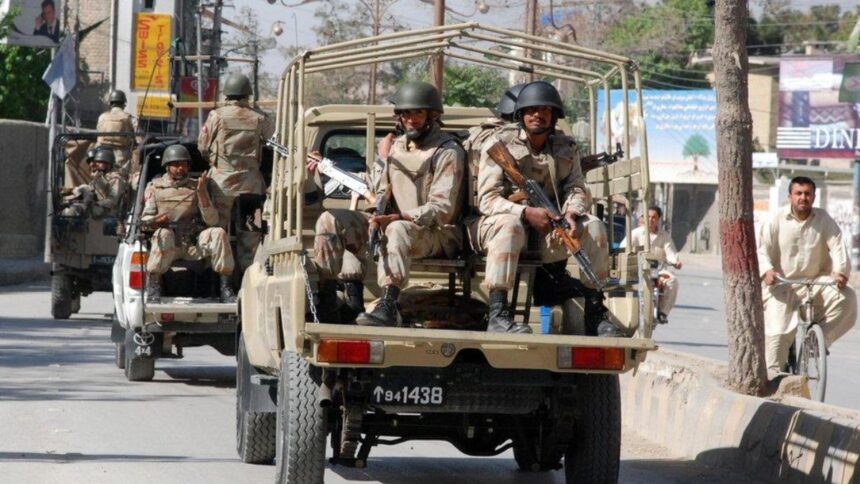
Pakistani security forces killed 11 terrorists in two separate intelligence-based operations in Balochistan’s Kharan and Washuk districts, the military’s media wing said, as the province continues to face a sustained wave of militant violence.
The Inter-Services Public Relations (ISPR) said eight terrorists were killed in Kharan on September 6 after militants tried to set up a roadblock to disrupt local traffic. Security forces “promptly intercepted and engaged” the group, according to the statement.
A day later in Washuk, troops exchanged intense fire with militants holed up at a hideout, killing three more. Forces recovered roughly 2.9 tonnes of explosives from the site, material ISPR said was intended for use in improvised explosive devices.
No security personnel were reported killed in either operation. ISPR said sanitization operations were continuing in both districts to clear the area of any remaining militants.
Military blames India-backed network
ISPR described the militants as belonging to “Fitna al Hindustan,” the label Pakistan’s military has increasingly used this year for groups it accuses of operating with Indian sponsorship in Balochistan. The statement said the operation had “neutralised 11 Indian-sponsored terrorists.”
President Asif Ali Zardari said the “nefarious designs of terrorists who are active under Indian patronage will be thwarted at all costs.” Interior Minister Mohsin Naqvi commended the security forces’ “professional skills” in carrying out the raids.
India has previously and repeatedly denied Pakistani accusations that it funds or directs separatist and militant groups in Balochistan.
Violence has climbed through the summer
The Kharan and Washuk raids are the latest in a string of operations across Balochistan, where attacks have risen steadily since midyear. Recorded militant attacks in the province climbed from 83 in July to 89 in August, according to figures cited in Pakistani reporting on the security situation, making Balochistan the country’s most volatile province through much of 2026.
Wire Examiner reported on September 6 that security forces had killed 48 terrorists in a separate round of operations across the province, part of the same broader offensive against militant networks operating along Balochistan’s border regions and in its interior districts.
Kharan and Washuk both lie in Balochistan’s sparsely populated southwest, near the Iranian border, a stretch of terrain security analysts describe as difficult to police because of its size and the scarcity of paved roads. Militants have used the area for cross-border movement and to stage attacks on highways linking Balochistan to the rest of Pakistan.
The insurgency has drawn in multiple armed groups, including Baloch separatist factions and Tehreek-e-Taliban Pakistan-linked militants, complicating the security picture for a province that also hosts major Chinese-backed infrastructure and mining investment under the China-Pakistan Economic Corridor.
That overlap between militancy and economic development has raised the stakes for Islamabad, which has repeatedly pledged that mineral and infrastructure projects in Balochistan will proceed despite the security challenges.
The frequency of ISPR statements announcing operations, several times a week in recent months, reflects both the scale of the military campaign and the province’s persistent instability. Officials have not given a timeline for when the current offensive might wind down.