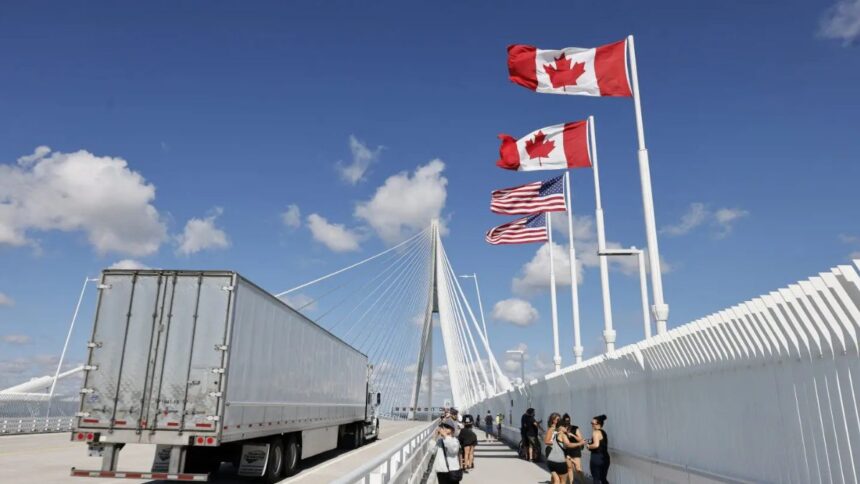
The United States has banned imports of most Canadian alcohol, dairy products and motorcycles, sharply escalating a trade war between the two longtime allies just hours after Canada’s own retaliatory tariffs took effect.
Tit for Tat Trade Measures
The White House said the new import bans will take effect on September 29, according to Reuters. They followed Canadian retaliatory tariffs on 20 billion dollars of US goods that kicked in after midnight on Tuesday, which themselves came in response to 50 percent US tariffs on Canadian goods imposed last month after negotiations collapsed.
President Donald Trump also moved to shut Canadian firms out of large, long-term US government contracts on the same day, the Associated Press reported.
Canadian Prime Minister Mark Carney defended his government’s retaliation and said Canada would accelerate efforts to reduce its reliance on the US market. “It was easy business, but it meant we relied too much on one economic partner,” Carney said, according to AP. “That time is over.”
Deepening Rift
More than 70 percent of Canadian exports still go to the United States, underscoring the scale of the disruption facing Canadian producers. A Reuters/Ipsos poll found only 20 percent of Americans approve of Trump’s tariffs on Canadian goods, while an Angus Reid poll showed Carney’s approval rating climbing 11 points to 62 percent following the announcement.
Trump has separately threatened to raise tariffs on Canadian cars, trucks and auto parts to 50 percent starting in January, adding to doubts about the future of the US-Mexico-Canada Agreement (USMCA), which is due for review this year.
A Wider Pattern Pakistan Should Watch
For Pakistan, the US-Canada rupture is a reminder of how quickly Washington has shown itself willing to use tariffs and import bans as leverage against even its closest trading partners, a posture that has also shaped recent rounds of US tariff talks with Islamabad over textile and apparel exports.
Pakistan’s own trade officials have repeatedly cited the need to diversify export markets beyond the US and China, a strategy Carney is now pursuing more aggressively as Canada looks to Europe and Asia to offset losses at home. Pakistani exporters and policymakers will likely watch closely whether the USMCA survives its scheduled review intact, since any weakening of North American trade rules could signal how Washington approaches trade agreements more broadly.