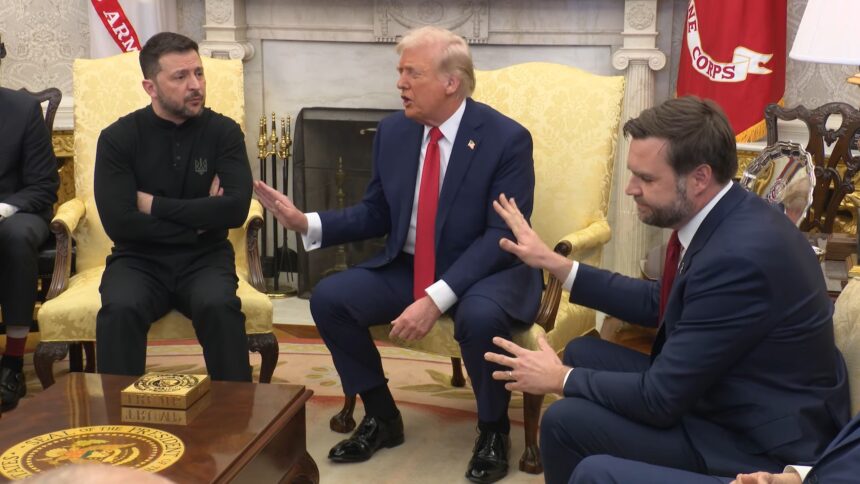
US President Donald Trump said Tuesday that Russian President Vladimir Putin wants a peace deal to end the war in Ukraine, but claimed the personal animosity between Putin and Ukrainian President Volodymyr Zelenskyy remains the biggest obstacle to a final agreement.
“The holdup is two people that hate each other,” Trump told reporters. “I think more than anything else, it’s two people that hate each other. I know about deals, and these are two people that are tired of fighting.”
Trump said he had a phone call with Putin on Tuesday, describing it as “a great conversation.” He said Putin “is wanting to make a deal,” adding that things “would be very nice” if Zelenskyy shared that willingness.
Envoys shuttled between Moscow and Kyiv
The call followed a weekend of shuttle diplomacy. Trump’s envoy Steve Witkoff and son-in-law Jared Kushner traveled to Moscow for talks with Putin before heading on to Kyiv, as Wire Examiner reported at the time.
That diplomatic push unfolded even as fighting continued. Russia struck the headquarters of Ukraine’s domestic security service, the SBU, in Kyiv with a drone, an attack Wire Examiner covered here. A separate Russian strike near Kyiv last month killed 37 people in one of the deadliest single attacks of the year, according to Wire Examiner’s earlier report.
According to CBS News, Russia resumed attacks on Kyiv on Tuesday morning during what was meant to be a temporary ceasefire tied to the envoys’ visit, killing at least two people. The White House did not release its own summary of the Trump-Putin call, and only Moscow offered an official readout, the network reported.
Per that Russian account, Trump indicated that ending the conflict would allow US-Russia relations to be “fully restored,” and said he hoped for a breakthrough during his presidency.
Death toll and a possible three-way meeting
Trump put a number on the human cost driving his urgency. “Too many people are dying in that war,” he said. “25,000 last month.”
He also did not rule out a meeting between himself, Putin, and Zelenskyy. “It could happen,” Trump said. “We had a good conversation. It could happen.”
Zelenskyy, for his part, said he welcomed the renewed American effort. He said he appreciated the US team’s work in “restarting the negotiation process” and that Kyiv had discussed “all the possibilities” with Washington’s negotiators, according to Outlook India.
Trump’s comments mark a notable shift in tone. He had pledged during his campaign to end the war within his first day back in office, a promise he has since called “figurative” or “an exaggeration” as the conflict ground into its fourth year.
Why it matters beyond Washington
The renewed push for a Ukraine settlement carries weight well beyond Europe. A prolonged war has kept global energy and grain markets volatile, a dynamic Pakistan has felt directly through fuel price swings and import costs that ripple into the Pakistani rupee and the country’s trade balance. Islamabad has also had to navigate its own balancing act between Washington, Moscow, and Kyiv as it seeks investment and diplomatic goodwill from all sides.
Pakistan has largely stayed out of direct mediation on Ukraine, unlike its more active role in easing tensions elsewhere, including its recent push on Iran-US mediation. But any durable peace deal that stabilizes oil markets would be welcomed in Islamabad, which has repeatedly raised fuel prices this year citing volatility tied to conflicts in the Middle East and Eastern Europe.
For now, the path to a deal remains uncertain. Trump’s own framing, that the war’s continuation owes as much to personal animosity between two leaders as to unresolved territorial or security disputes, suggests Washington sees the human factor, not just the terms on paper, as the harder problem to solve.
Whether envoys Witkoff and Kushner can translate this week’s talks into a formal framework, or whether the Putin-Zelenskyy rift proves as intractable as Trump suggests, is likely to shape the next phase of negotiations in the weeks ahead.