
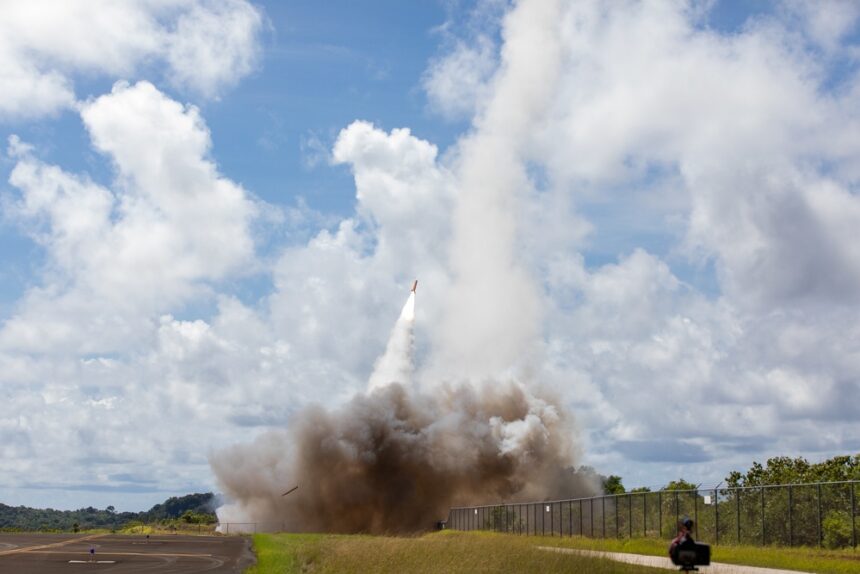
US Patriot missile batteries fired dozens of interceptors in rapid succession on Wednesday to stop an Iranian ballistic missile barrage aimed at a base used by American forces in Jordan, according to video analysis circulated by open-source defense trackers.
Footage from the engagement showed Patriot launchers firing interceptors in a rapid sequence that observers likened to a “machine-gun mode,” United24 Media reported. The barrage targeted the Al Azraq area, where the United States maintains a military presence.
Twenty missiles, eighteen intercepts
The Jordanian Armed Forces said air defenses intercepted 18 of the 20 ballistic missiles Iran launched toward Jordanian territory. The remaining two fell in remote, unpopulated areas, and no casualties were reported.
Open-source analysts who reviewed nighttime video of the intercepts estimated that US crews fired somewhere between 60 and more than 100 PAC-3 MSE interceptors to bring down the incoming missiles, a ratio of roughly three to five interceptors for every Iranian missile. Neither the Pentagon nor Jordanian officials have confirmed an exact figure.
US officials described the attack as “ineffective” and said all American personnel were accounted for. Iran claimed its missiles caused heavy damage to US facilities, but those claims have not been independently verified.
Video evidence reviewed by defense outlets also suggested some of the Iranian missiles carried cluster submunitions rather than a single warhead, which would have forced defenders to track and engage multiple smaller objects from a single incoming missile and helps explain the high number of interceptors fired.
A costly way to stay safe
The scale of the response has renewed attention on the price of missile defense. A single PAC-3 MSE interceptor costs the Army roughly 4 million dollars, according to budget documents cited by defense trade press, putting the notional cost of Wednesday’s engagement somewhere between 240 million and 500 million dollars in interceptors alone.
That cost asymmetry, in which a defender can spend far more than an attacker per exchange, has been a recurring theme of the wider air war between the United States and Iran. The Army has moved to expand PAC-3 production lines and is developing a cheaper variant, the PAC-3 ACE, partly to address concerns that interceptor stockpiles cannot keep pace with sustained use across multiple theaters at once.
Congressional and defense industry scrutiny of the PAC-3 supply chain has grown as the war has stretched on, with lawmakers pressing the Army on whether production can be accelerated fast enough to replace interceptors expended at this pace across multiple fronts, including US commitments in the Gulf, the Red Sea and Indo-Pacific allies who rely on the same missile family.
This is not the first time Iran has targeted US positions in Jordan. Strikes on American-linked bases there in July killed at least two US military personnel, part of a pattern of escalation that has continued despite periodic rounds of diplomacy between Washington and Tehran.
Part of a six-month war
Wednesday’s exchange came roughly six months into the US and Israeli campaign against Iran, which began on February 28 with strikes that killed senior Iranian officials. Since then Iran has largely closed the Strait of Hormuz to its own shipping while the United States enforces a naval blockade on Iranian ports, and Wire Examiner has previously reported on US strikes against Iranian oil tankers and Iran’s claimed strikes on vessels in the Gulf.
Brent crude has climbed toward 100 dollars a barrel as the fighting has dragged on, and talks between Washington and Tehran over a memorandum to end the war have so far failed to stop the exchanges of fire.
Why it matters for Pakistan
Pakistan has stayed officially neutral in the conflict while positioning itself as a potential mediator between Washington and Tehran, an effort Wire Examiner has covered as it has developed. Islamabad shares a roughly 900 kilometer border with Iran, and millions of Pakistanis work in Gulf states now within range of Iranian missile and drone activity.
The economic spillover is also direct. Rising oil prices tied to the war have already pushed Pakistan’s domestic petrol price to 364.35 rupees a liter under a newly adopted daily pricing mechanism, and further escalation of the kind seen in Jordan this week is likely to add more pressure at the pump.
With Iran signaling no willingness to stand down and US air defenses again forced into high-volume engagements to protect its forces, analysts say the risk of a wider regional escalation, and further disruption to Gulf shipping and oil markets, remains elevated.