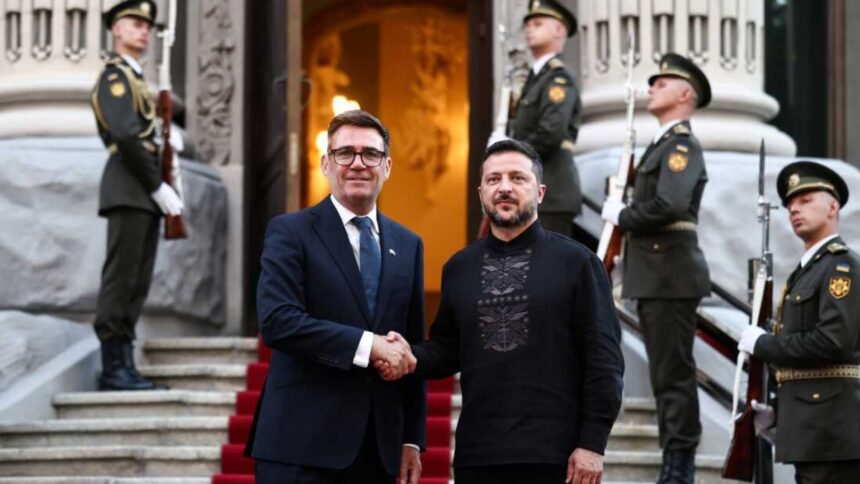
Britain said this week it will release classified technical information on UK-made components of the SCALP cruise missile, allowing Ukraine to begin assembling the long-range weapon domestically, a move UK Prime Minister Andy Burnham announced during a visit to Kyiv to mark Ukraine’s Independence Day.
What Was Announced
Burnham said defence firm MBDA will release details on British-made parts for the SCALP missile, known in the UK as Storm Shadow, to help Ukraine assemble the weapons domestically. France and Ukraine want to establish a Ukrainian production line for the missile by the end of the year, and the declassification of British component information is described as a key step toward that goal.
SCALP is a conventionally armed, long-range, deep-strike weapon with a range of more than 250 kilometres, fired from Ukraine’s Su-24 or Mirage 2000 fighter jets. It uses a combination of satellite positioning and terrain-reference navigation, along with an infrared seeker, to strike hardened targets such as buried command bunkers with a high degree of accuracy in most weather conditions. Ukraine has used imported versions of the missile since 2024, including strikes against targets inside Russia.
Russia’s Response
The Kremlin reacted angrily to the announcement. Spokesman Dmitry Peskov said the UK was “participating in the war” and “pouring fuel on the fire.” His comments followed a warning issued last week by the Russian embassy in London, which said that the deeper Britain’s involvement and the greater its support for Ukraine, the higher the price it would ultimately pay.
Neither Britain nor France has disclosed how many SCALP or Storm Shadow missiles have been supplied to Ukraine to date. French Defence Minister Sebastien Lecornu said last year that manufacturer MBDA had reactivated production lines that had been shuttered for 15 years, after the missile demonstrated its effectiveness in what he described as decisive combat situations.
Experts Question the Near-Term Impact
Analysts have cautioned that the declassification will not translate quickly into operational missiles. “Any impact will in part depend on how quickly Ukrainian-assembled SCALP cruise missiles can be introduced into service,” said Douglas Barrie, a senior fellow at the International Institute for Strategic Studies. Arun Dawson, a researcher at the Freeman Air and Space Institute at King’s College London, said the announcement is unlikely to help Ukraine through the coming winter and will probably not have a meaningful effect until next year at the earliest, adding that Ukraine’s more pressing need is protection from Russian ballistic missile attacks rather than additional deep-strike capability.
Ukraine has separately developed its own long-range weapons, including the domestically built FP-5 Flamingo cruise missile, which has a range of 3,000 kilometres and was used earlier this month to strike a Russian rocket electronics facility roughly 900 kilometres from the Ukrainian border, according to President Volodymyr Zelensky.
Why It Matters
The announcement reflects a broader shift in how Ukraine and its Western backers are approaching the war, as Kyiv increasingly targets facilities deep inside Russian territory in an effort to raise the costs of the invasion for Moscow. Whether British-enabled domestic missile production meaningfully expands Ukraine’s strike capacity will depend on how quickly a Ukrainian assembly line can be established and scaled, a process officials and analysts agree is likely to take considerably longer than the political announcement itself suggests.