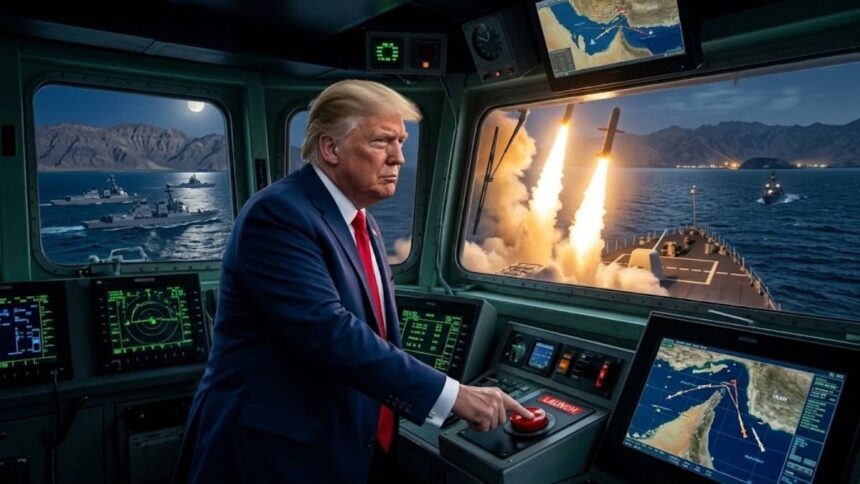
The United States carried out fresh strikes on Iranian military targets on Tuesday, opening a new round of fighting in the Strait of Hormuz after a monthlong lull, according to U.S. Central Command and Iranian state media.
CENTCOM Confirms New Strikes
“Today at 12 p.m. ET, U.S. forces began striking Islamic Revolutionary Guard Corps (IRGC) targets in Iran,” CENTCOM said in a statement posted on X.
The command said the strikes followed recent attempted attacks by the IRGC on commercial shipping in the Strait of Hormuz and against American troops stationed in the region. Iranian state television reported the strikes hit an airport in the southern province of Kerman.
Trump Calls Strikes “Large and Powerful”
President Donald Trump described the operation as retaliation in a Truth Social post, saying U.S. forces were “striking Iranian Targets near the Strait of Hormuz” in response to what he called a failed Iranian attempt to plant sea mines in the strait, and to a barrage of eight missiles Iran fired at a U.S. base in Jordan, all of which he said were intercepted.
Trump called the operation a “very justified attack” and warned Iran would face a heavier response if it retaliates, saying the U.S. was still holding back “the biggest attack of them all.”
Iran Vows a “Decisive Operation”
Iran’s Armed Forces Central Headquarters said it would “deliver crushing and devastating blows” against what it called the “American enemy,” according to state broadcaster IRIB.
The state-run Tasnim and Fars news agencies, both seen as close to Iran’s security establishment, reported that Iran’s armed forces had launched a “decisive operation” in response to the U.S. strikes, and said American bases and interests across the region would be targeted by Iranian missiles and drones.
Tasnim also said Iran’s newly deployed air defense system shot down a U.S. MQ-9 drone over the Khomein area, though this has not been independently confirmed by U.S. officials.
Tehran Says It Still Controls the Strait
Iranian parliament speaker Mohammad Bagher Ghalibaf said Iranian forces were resisting American efforts to move ships through Hormuz. He acknowledged that “the enemy managed to get some ships” through the strait, but insisted Iranian forces remain “in complete control of the strait and will not allow it to be opened.”
Ghalibaf accused Washington of giving shipping companies “false guarantees” about safe passage on a southern route he said violates the memorandum of understanding reached between the two countries in June. Vessels attempting that route, he said, are being targeted.
Tanker Attacks Preceded the Strikes
The latest exchange follows a weekend in which the U.S. military struck Iranian rocket launchers on Larak Island, saying Iranian forces there were preparing to fire rockets carrying sea mines into the strait. Iran responded by launching missiles at U.S. sites in Jordan and the United Arab Emirates, which the UAE said it intercepted along with a drone over its territorial waters.
Separately, the UK Maritime Trade Operations agency reported that an oil tanker was struck by three projectiles off the coast of Oman as it left the Strait of Hormuz on Monday evening, part of what maritime security firm Marisks described as a possibly coordinated series of attacks on shipping.
Six Months of Escalation
Tuesday’s strikes are the latest chapter in a war that began on February 28, 2026, when the U.S. and Israel launched joint strikes on Iranian military, government, and infrastructure sites. Iranian state media reported significant casualties in those initial strikes.
A memorandum of understanding reached in June sought to end the fighting and reopen Hormuz to shipping, but Iran continued to assert control over the waterway, prompting a U.S. naval blockade in April and an ongoing American air campaign aimed at reopening the strait. Roughly a quarter of the world’s seaborne oil trade normally passes through Hormuz.
The U.S. Embassy in Qatar issued a security alert on Tuesday warning of the potential for “unforeseen escalation,” urging Americans in the region to exercise heightened vigilance amid the possibility of flight cancellations and airspace closures.
Public Support for the War Remains Low
A Reuters/Ipsos poll released this week found just 36 percent of Americans approve of the war with Iran, with Trump’s overall approval rating at 33 percent. Oil prices rose more than 3 percent following news of the latest strikes.
Neither side has signaled willingness to step back. Trump has threatened an even larger strike if Iran retaliates again, while Iranian officials have repeated pledges to keep the strait closed to what they call unauthorized shipping.