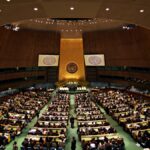
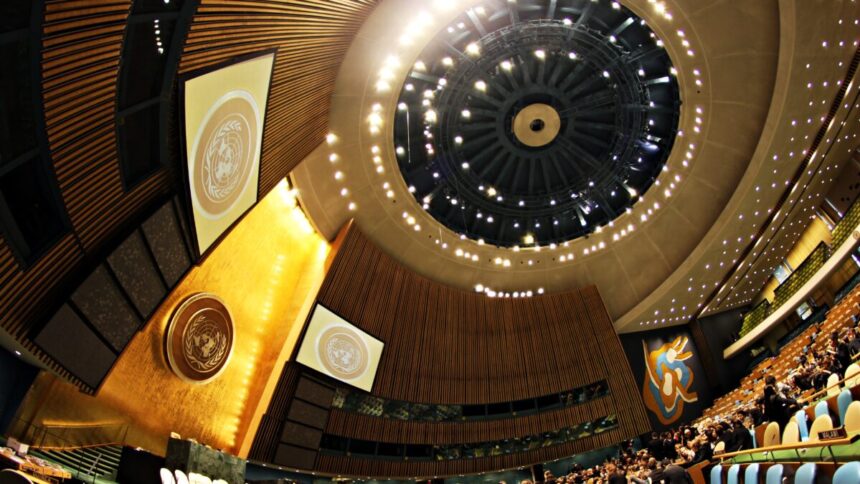
Two speeches delivered hours apart at the United Nations General Assembly this week captured just how far apart the world’s flashpoints remain from resolution. Ukrainian President Volodymyr Zelenskyy and Iranian President Masoud Pezeshkian each used their turn at the podium in New York to reject calls for restraint and instead accuse their adversaries of pushing the world toward greater danger.
Zelensky says Putin is making the world ‘more dangerous’
Addressing the 81st session on day two of the general debate, Zelenskyy told delegates that nearly five years of war have not slowed Moscow’s ambitions in eastern Ukraine. “For almost five years now, Russian generals have been trying to carry out Putin’s crazy order to seize our eastern land, the Donetsk region,” he said, according to UN News.
He cited roughly 249,000 Russian military casualties in the first eight months of 2026 alone, calling the toll disproportionate to the ground Moscow has gained. “It’s madness. But they still keep going,” he said.
The Ukrainian leader warned that a conflict left unchecked for too long tends to spread. “A war that was not prevented in time, was not stopped in time, and for which Russia was not punished in time, keeps spreading and spreads evil with it,” he told the chamber, adding that “the more freedom Putin has to act, the more dangerous the world becomes for everyone else.”
Zelenskyy also flagged a newer worry: the growing role of artificial intelligence in modern warfare. He urged member states to resolve current conflicts before an AI-driven era of fighting takes hold, and pressed allies to keep sanctions on Russian trade and financing intact, alongside continued joint weapons production and defense cooperation.
Pezeshkian accuses Washington and Israel of terrorism
A separate but similarly defiant tone came from Iran’s Pezeshkian, who used his address to turn terrorism accusations back on Iran’s harshest critics. “Those who are terrorists… describe us using that word,” he said, according to UN News, before displaying images he said showed former supreme leader Ayatollah Khamenei following what he called an unlawful assassination attempt in a joint US-Israeli strike in February.
Pezeshkian also showed photographs of children he said were killed in US and Israeli strikes on schools and sports facilities, arguing Iran has not attacked another country in two centuries despite being cast as a regional threat. “We have been the victims of terrorism,” he said.
On the nuclear file, Pezeshkian insisted Iran’s program serves medical, agricultural and industrial purposes rather than weapons development, and accused Western governments of a double standard, noting that Israel is not a member of the Nuclear Non-Proliferation Treaty and faces no comparable inspections regime, Foreign Policy reported.
He closed with a direct message to US President Donald Trump, saying “the resistance of the Iranian people will only increase in the face of sanctions, pressure, and bullying,” and described Israel’s campaign in Gaza as genocide, citing a death toll of roughly 80,000 civilians.
Two crises, one shared message of defiance
The pairing of speeches, arriving on the same day as a mass walkout during Israeli Prime Minister Benjamin Netanyahu’s address, underlined a broader pattern at this year’s session. Rather than seeking common ground, leaders from several of the world’s most contested conflicts used the UN floor largely to restate grievances and reject blame, leaving little sign of fresh diplomatic movement on either the Ukraine war or the Iran standoff.
That dynamic has left the General Assembly functioning less as a venue for compromise this year and more as a stage where rival narratives are broadcast side by side to the same audience of foreign ministers and diplomats.
Where Pakistan fits into this year’s session
Pakistan has positioned itself as a quiet go-between on the Iran file this year, with officials saying Prime Minister Shehbaz Sharif intends to raise Islamabad’s efforts to ease tensions between Washington and Tehran when he addresses the assembly later this week. Pakistan shares a long border and deep trade ties with Iran, giving it a direct stake in whether the standoff escalates further.
On Ukraine, Islamabad has kept a more neutral posture than many Western capitals, a position consistent with its broader approach to the conflict since 2022. That balancing act, between a Gulf and Iranian neighborhood on one side and a Western-aligned security relationship on the other, is likely to shape how Pakistani diplomats read this week’s dueling speeches at Turtle Bay.