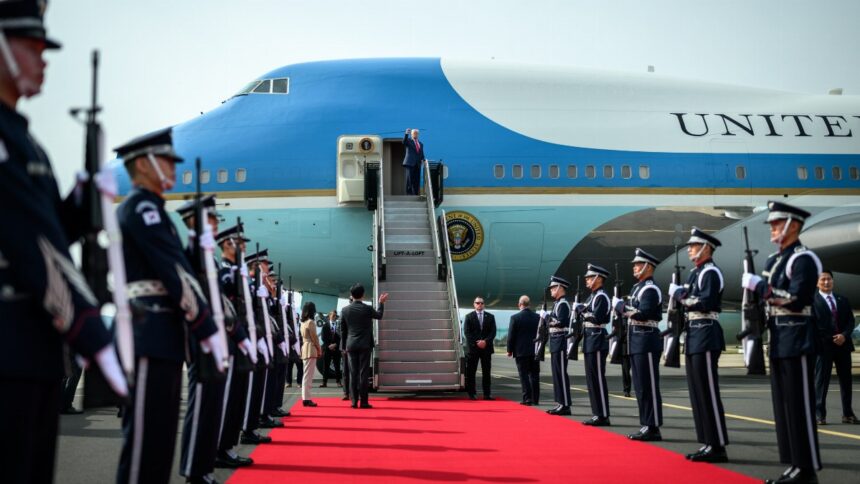
US President Donald Trump welcomed Chinese President Xi Jinping to the White House this week for a state visit that produced a fresh extension of the two countries’ fragile trade truce, even as unresolved disputes over Taiwan and artificial intelligence hung over the talks.
Xi and his wife, Peng Liyuan, were greeted with a rare red carpet welcome at Joint Base Andrews on Wednesday evening before a full ceremonial reception at the White House on Thursday, complete with a military flyover, bilateral talks and a state dinner. Friday’s schedule included tea at the White House and a visit to the National Archives, according to Al Jazeera.
Trade truce extended into the new year
The centerpiece announcement was an extension of the 11-month trade truce between Washington and Beijing, pushing the deadline to January 10. The two sides had been operating under a tariff ceasefire first struck last year, and this week’s talks kept that arrangement alive rather than resolving it outright.
At the same time, the Trump administration moved ahead with new 12.5 percent tariffs tied to concerns over forced labor in Chinese supply chains, a signal that even a friendly summit has not erased the underlying friction between the two economies. Soybeans, semiconductors and rare earth minerals remained central bargaining chips heading into the meeting, with both governments eager to show tangible wins to domestic audiences.
Taiwan arms sales remain a flashpoint
Taiwan policy proved one of the trickiest parts of the visit. An $11 billion US arms sale to Taiwan that had already been approved went ahead, but a separate $14 billion package was left on hold. Trump has described that pending sale as a “negotiating chip” in the broader relationship with Beijing, a framing likely to draw criticism from lawmakers who see US commitments to Taiwan as separate from trade leverage.
China has long objected to American arms sales to the self-governed island, which Beijing claims as its own territory. Keeping the larger package unresolved allows both leaders to avoid a public rupture this week while leaving the issue for future negotiations.
AI safeguards and detained Americans on the agenda
Washington also proposed a new “notification mechanism” meant to alert each government when the other detects an AI-related incident with national security implications, part of a broader effort to manage the rapid buildup of artificial intelligence capabilities on both sides. The idea reflects growing unease in both capitals that AI systems could trigger a crisis neither government intended.
Trump also used the visit to press for the release of additional American citizens and others detained in China, an issue that has featured in nearly every recent high-level exchange between the two governments but has yielded only limited results. It remains unclear whether Xi offered any commitments on that front, or on whether China might use its influence to affect ongoing negotiations involving Iran.
Third meeting in under a year
This marks the third in-person meeting between the two leaders in less than 12 months, following a bilateral sit-down in Busan, South Korea, last October and Trump’s own state visit to Beijing in May. That pace of engagement is unusual by recent US-China standards and suggests both governments see value in maintaining direct contact even as structural tensions persist.
First Lady Melania Trump, in comments ahead of the visit, said of the Chinese delegation, “He’s coming on our soil, and we need to welcome them” with “the most respect,” according to the White House. The ceremonial tone of the visit, red carpet and all, was widely read as an attempt to project stability in a relationship that has swung between confrontation and cooperation over the past several years.
Why it matters beyond Washington and Beijing
The outcome of the Trump-Xi summit carries weight well beyond the two countries involved. A stable trade relationship between the world’s two largest economies tends to ease pressure on global supply chains and commodity prices, both of which affect import-dependent economies. Continued uncertainty over tariffs and technology restrictions, on the other hand, can ripple through markets that have little direct stake in the dispute itself.
Analysts describe the current arrangement as a “reprieve in hostilities” rather than a lasting resolution, testing whether the two governments can sustain what officials have called constructive strategic stability despite competing interests in trade, technology and regional security. With the trade truce now set to expire in January, both sides face pressure to convert this week’s goodwill into a more durable agreement before the clock runs out again.
A relationship still finding its footing
The US-China relationship has lurched between tariff escalations, export controls and diplomatic overtures for much of the past two years, leaving businesses and governments elsewhere trying to plan around a rivalry that shows no sign of fully resolving. Each new summit tends to buy a few more months of predictability without settling the deeper disagreements over technology dominance, Taiwan and regional security in Asia.
For now, officials in both Washington and Beijing appear content to keep talking rather than let the relationship slide back into open confrontation. Whether that holds once the trade truce nears its January deadline will likely shape the tone of the next round of talks, and possibly the next Trump-Xi meeting after that.