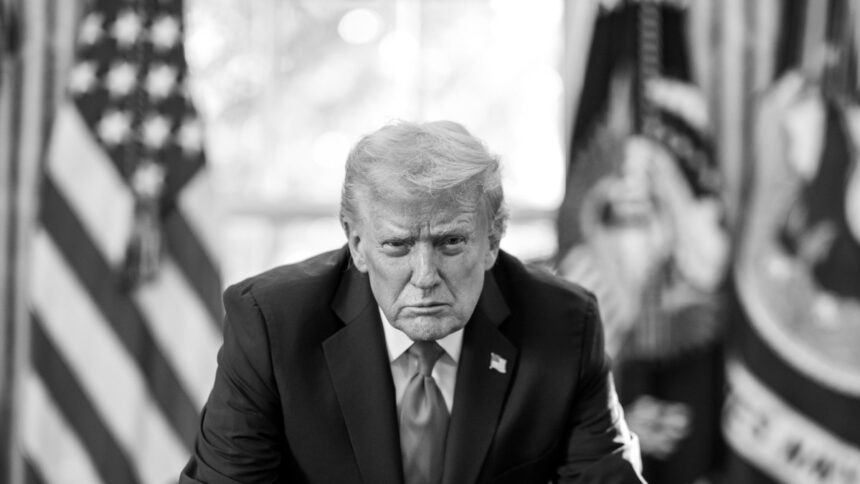
President Donald Trump said Saturday he has entered “deciding mode” on Iran, warning that “very big things are going to be happening in the not-so-distant future” as tensions between Washington and Tehran edge toward a new flashpoint.
In a Fox News interview, Trump laid out what he described as three options on the table: a decisive military strike, a strategy of economic strangulation, or a renewed push for direct diplomacy with Tehran. “My question is if and when do I blow the entire nation up? They had better behave,” he said, according to the interview cited by Anadolu Agency and other outlets.
Three options, one deadline
Trump did not specify a timeline for a decision, but the framing of an imminent choice, rather than an open-ended review, is itself a shift in tone from earlier this year, when the administration had signaled a preference for sanctions pressure over military escalation.
He also left the door open to diplomacy, saying he would be willing to meet Iranian President Masoud Pezeshkian on the sidelines of the United Nations General Assembly, which opens this week in New York. Whether that meeting happens may itself signal which of the three paths the White House is leaning toward.
Trump additionally claimed the United States has been in direct contact with Yemen’s Houthi movement, saying the group had agreed to avoid confronting American forces even as it continues to target Saudi Arabia.
Houthi attacks raise the stakes
The Iran comments land just hours after Houthi rebels fired a barrage of ballistic missiles at Riyadh, marking one of the most direct assaults on the Saudi capital since the Yemen war began. Saudi officials have vowed what one described as a “very sizeable” response, according to regional reporting.
Because Iran is widely understood to arm and direct elements of the Houthi movement, the Riyadh attack complicates any US calculus on Tehran. A military strike on Iran now carries the added risk of triggering retaliation across multiple fronts at once, from the Red Sea to the Gulf.
Iran, for its part, has laid out its own conditions through back-channel diplomacy. Tehran’s security chief, Mohsen Rezaei, reportedly used Qatari mediation to demand an end to hostilities, the unfreezing of Iranian funds held abroad, and a halt to naval blockades affecting Iranian shipping, a signal that Tehran still sees room for a negotiated off-ramp even as Washington’s rhetoric hardens.
Pakistan’s quiet stake in the outcome
The standoff is not a distant story for Pakistan. Islamabad shares a long, porous border with Iran and has spent recent weeks working discreetly to keep a US-Iran channel open. Interior Minister Mohsin Naqvi traveled to Tehran this week as part of what Wire Examiner reported was a quiet mediation effort, one of several such trips by Pakistani officials shuttling messages between Washington and Tehran.
A US military strike on Iran would put that mediation effort, and Pakistan’s own border security, under immediate strain. Past periods of Iran-US tension have driven refugee flows and militant activity across the Pakistan-Iran frontier in Balochistan, a province already contending with a separate insurgency. Pakistani officials have also worried publicly about the economic fallout of a wider Gulf conflict, given the country’s reliance on remittances from Gulf states and its exposure to oil price shocks.
Beyond the immediate region, a US-Iran confrontation would also test global oil markets and shipping through the Strait of Hormuz, a chokepoint for roughly a fifth of the world’s oil supply. Analysts have long warned that even the threat of military action can send crude prices higher, an effect that would be felt at the pump well beyond the Middle East.
Why it matters
Trump’s language marks one of his most explicit public threats against Iran since returning to office, and it comes at a moment when the region is already absorbing shocks from the Houthi missile campaign, the ongoing Gaza fallout, and Israeli-Palestinian friction around Jerusalem’s holy sites. Whether Trump ultimately chooses military action, tighter sanctions, or a diplomatic reset, the decision is likely to be shaped as much by events in Riyadh and the Red Sea as by anything happening in Washington.
For now, both sides appear to be signaling through public statements rather than committing to a fixed course, leaving open the possibility of a Trump-Pezeshkian encounter at the UN General Assembly this week that could either de-escalate the standoff or harden it further.