



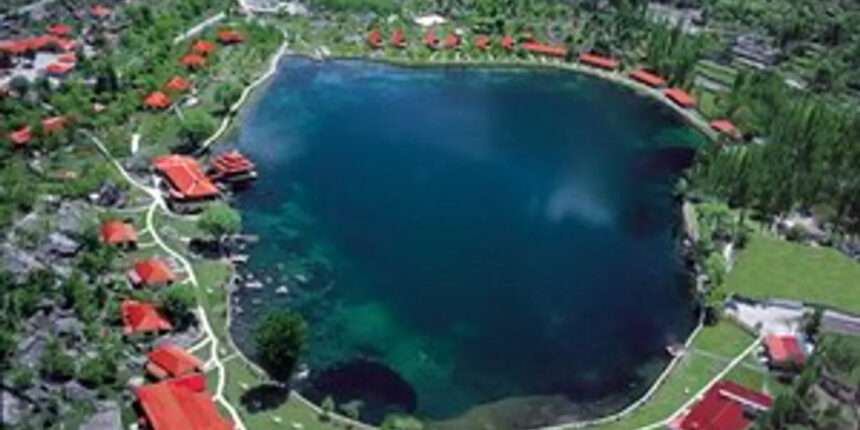
Skardu has three distinct features that set it apart from the rest of the world: firstly, its rugged terrain, secondly, the Deosai Plateau, and thirdly, boredom. Skardu’s airport is located in the desert amidst mountains; after the cold desert, it was another strange desert that we saw in Skardu. You can camp in this desert, but these are not the tents that were used in the Arabian deserts in ancient times; instead, these are Five Star tents that come with a bath and hot water facilities. We couldn’t go to Deosai this time because its route opens after July 15th, but these tents are available there too, to the extent that even Wi-Fi facilities are available in the world’s second-highest plateau.
This work has been started by a new tourism company that provides people with the convenience of staying in comfortable tents at Pakistan’s remote tourist destinations. Since I particularly enjoy comfort, I really liked this idea. Moreover, since I am not convinced about putting myself in discomfort, which adventure tour enthusiasts call adventure tourism, I do not endorse it. However, since there is no shortage of thrill-seekers in the world, the demand for this type of tourism is increasing day by day, and Skardu is the best place for it. Not only that, but there are also countless historical and religious sites in this entire region. Despite all these factors, tourism in Skardu is at zero. Why?
I’ve often reiterated that tourism is a complete package. When it comes to Skardu, a large number of foreigners arrive on the incoming flights. However, these people don’t come to Skardu under the influence of any governmental propaganda but rather out of their own passion for adventure tourism. On the flight we took back, there were tourists from Thailand, China, Japan, and Indonesia, among many other countries, and they all had come to Skardu driven by their own desire for adventure. While it’s true that these tourists likely stayed in hotels, rented cars, and dined out, benefiting the local people, Skardu doesn’t actually earn anything from them because the government hasn’t imposed any tourism or city taxes on hotels or services.
Ostensibly, the local people are strongly against any form of taxation. On the other hand, if you visit famous tourist cities worldwide, hoteliers levy city taxes on top of rental charges, which are then spent within the city. So, the first task the government should undertake is to compel foreigners in Skardu to make payments in local currency, similar to the system in airports in Dubai or Doha, where if you purchase a cup of tea and pay in dollars, the rest of the amount is returned to you in local currency. This same method can be implemented in Skardu. The second task is the implementation of city taxes, collecting them from both local and foreign tourists, with the revenue solely spent in Gilgit-Baltistan, independent of the federal government. The third and most crucial task is the development of mountaineering tourism.
The last village in the district of Shigar where there is human habitation, Askole exists. The distance from here to K2 Base Camp is approximately 90 kilometers, but it’s at least a seven to eight-day journey on foot. Obviously, only those individuals who have an obsession with climbing K2 venture to this base camp. Such was the passion of Jan Snorri, who hailed from Iceland and also of Ali Sadpara, his porter. A porter’s job involves carrying the equipment of a mountaineer and assisting them to the summit. These porters, though they accompany climbers to all the peaks, often go unrecognized. It’s only the organization of mountaineering that acknowledges them, and only the climbers’ achievements are usually recorded, like when a certain climber conquers Mount Everest or K2.
On February 5, 2021, Ali Sadpara, Jan Snorri, and another mountaineer set out, but the weather turned extremely bad. Sadpara attempted to dissuade them from this adventure, but they both didn’t consider themselves mountaineers. Reluctantly, Sadpara had to accompany them, and tragically, they lost their lives while attempting to summit K2, at a place known as the “Bottleneck,” also referred to as the “Death Zone.”
Another porter, Hassan Shigri, had an even more tragic fate. He had been hired by an international mountaineering team last year, but fate had it that he faced trouble at the same Bottleneck location and fell. While mountaineering teams from Norway, led by the renowned climber Kristin Herylla, had Nepali porters known as Sherpas accompanying them, who were much more trained and equipped compared to Pakistani porters. They were adept with all kinds of gear, and their clothing was superior and safer, equipped even with satellite phones for communication while summiting. Kristin Herylla saw Hassan Shigri fall on the way but chose to ignore it and continued ahead, while another Sherpa captured the incident on a satellite phone’s video, which was then circulated globally.
The viral spread of this video shook the mountaineering world. Hassan Shigri met his demise at the Bottleneck, while Kristin Herylla successfully summited K2. I am not sure if Skardu benefits from mountaineering tourism or not; most likely, we gain nothing from it.
In my opinion, a fee should be imposed on climbers for mountaineering, and this amount should be spent on Pakistani porters. If a country like Nepal can train its porters to become Sherpas, then why can’t we do the same? The work of a porter is significant even beyond mountaineering. If Ali Sadpara and Hassan Shigri had the facilities and training like the Sherpas, perhaps their deaths wouldn’t have been as tragic.
We have returned from Skardu, but our hearts are not fulfilled; at least once again, we intend to go. We want to spend a night in Deosai, witness the wonders of nature, and awaken the sense of our belonging. Let’s see when we get the opportunity again!

