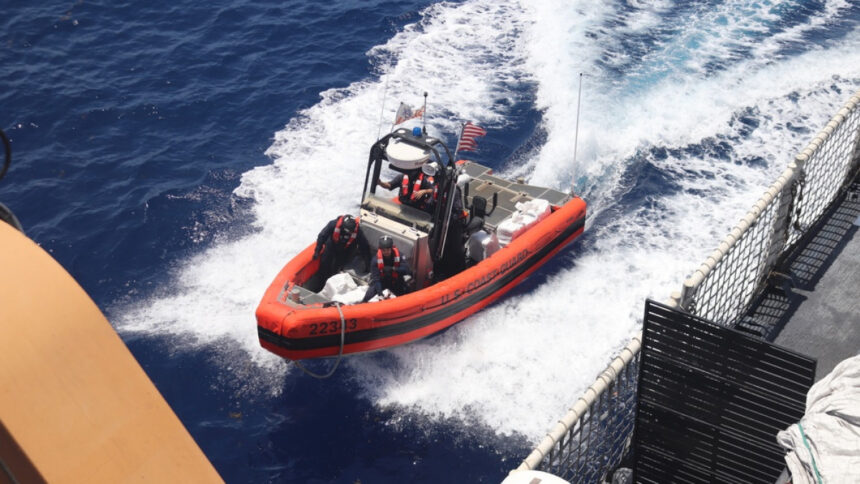
The US military said on September 19 that it had killed four people in a strike on a boat it accused of smuggling drugs in the Caribbean Sea, the latest in a campaign that has now killed well over 200 people since it began a year ago.
US Southern Command said “confirmed intelligence” showed the vessel was actively involved in narco-trafficking, according to Reuters and other outlets that first reported the strike. The military did not name those killed or their nationalities, and it offered no public evidence to back the claim, a pattern rights groups say has repeated across the campaign.
President Donald Trump has described the effort as an “armed conflict” with drug cartels, arguing that lethal strikes are necessary to cut the flow of narcotics and overdose deaths into the United States. Defense Secretary Pete Hegseth has pushed the campaign further into the region, announcing during a visit to Panama that Colombia, Guatemala, and Honduras had agreed to joint military operations against criminal groups, though Guatemala later disputed that characterization.
A year of strikes, little evidence
The Caribbean strike is part of a wider operation that began in September 2025 and has expanded into the Eastern Pacific and, at times, land targets inside Venezuela and Ecuador. By some counts the campaign has now carried out roughly 68 strikes and killed more than 227 people, with victims reported from Venezuela, Colombia, Ecuador, Trinidad and Tobago, and Saint Lucia.
The administration has labeled its targets “narcoterrorists,” pointing chiefly to the Venezuela-linked Tren de Aragua network and Colombian guerrilla groups. It has rarely released evidence tying individual boats or passengers to trafficking, which is the core of the legal objection now surrounding the operation.
UN human rights experts have called the strikes “extrajudicial executions,” and the UN High Commissioner for Human Rights has formally demanded Washington halt the campaign. Luis Moreno Ocampo, a former International Criminal Court prosecutor, has said the killings could amount to crimes against humanity. Human Rights Watch and Amnesty International have echoed that assessment, and legal scholars have separately questioned whether the strikes comply with maritime and international humanitarian law.
Congress has twice declined to rein in the campaign. A resolution from Senators Adam Schiff and Tim Kaine that would have required congressional approval for further strikes failed in the Republican-controlled Senate, 51-48, in October 2025.
Why it matters for Pakistan
The debate over strikes carried out on suspicion, without trial, and often without disclosed evidence is not new to Pakistan. Washington’s drone campaign against alleged militants in Pakistan’s tribal areas during the 2000s and 2010s drew similar objections: a UN special rapporteur found in 2013 that at least some strikes violated Pakistan’s sovereignty, and Pakistani courts and officials repeatedly pressed Washington for accountability over civilian deaths that the US rarely acknowledged in detail.
The Caribbean campaign follows a similar shape, a foreign military claiming the right to kill suspects outside its own borders based on intelligence it does not make public, and a home government largely left to accept the outcome. For Islamabad, which has spent more than a decade arguing that such strikes set a dangerous precedent for state conduct, the legal fight now playing out over Latin American waters is a familiar one, even if the geography has changed.
Wire Examiner reported in August on the campaign’s resumption in the Pacific after a brief pause, when the administration restarted strikes following weeks of internal debate over their legal basis. The latest Caribbean strike suggests that debate has not slowed the operation’s pace.
No further details on the identities of those killed in the September 19 strike had been released as of this report. The Pentagon has not said whether it plans to continue strikes at the current rate, and the White House has given no indication it intends to change course despite the mounting international criticism.